OneDotDot Chinese Grammar · HSK 2 Grammar Point · HSK 2 是不是是不是 shì bú shì — “right?” / “isn’t it?” 是不是是不是 shì bú shì turns a sentence into a yes-no question, but it does more than ask. It seeks confirmation for something the speaker already believes, much like “…, right?” or “isn’t it?” in English….
Category: HSK 2
Although in Chinese – Suīrán
OneDotDot Chinese Grammar · HSK 2 Grammar Point · HSK 2 雖然 suīrán虽然 suīrán — “Although” 雖然 suīrán虽然 suīrán is the most common way to say “although” in Chinese. It usually opens the sentence or clause, and — unlike English, where “but” is optional — Chinese always needs a matching 但是 dànshì但是 dànshì, 可是 kěshì可是…

“When” in Chinese – Dāng
Grammar Point:The word 當当 dāng can function as a preposition and is often translated as “when” in English. It is a more formal way to express the phrase 的時候的时候 de shíhòudede shíhou. Structure 當/当 + Phrase The phrase 的時候的时候 de shíhòudede shíhou or 時时 shí are often used with 當当 dāng structure. 當dāng我的wǒde狗gǒu看到kàndào我wǒ, 他tā會huì一直yìzhí搖yáo尾巴wěibā当dāng我的wǒde狗gǒu看到kàndào我wǒ, 他tā会huì一直yìzhí摇yáo尾巴wěibāWhen…
“But” in Chinese 1 – 但是 dànshì
OneDotDot Chinese Grammar · HSK 2 Grammar Point · HSK 2 但是 dànshì — “But” 但是 dànshì is the most common, all-purpose word for “but” in Chinese. It works in both speaking and writing, and it’s usually the first “but” word learners meet. 但是 dànshì is a versatile, neutral word for expressing contrast — safe…
“Already” in Chinese 1 – yǐjīng and dōu
OneDotDot Chinese Grammar · HSK 2 Grammar Point · HSK 2 已經已经 yǐjīng & 都都 dōu — “Already” in Chinese 1 已經已经 yǐjīng and 都都 dōu both mean “already” — but 都 dōu adds a stronger emotional punch: surprise, frustration, or complaint. Both words show that something has already happened — the sentence almost always…
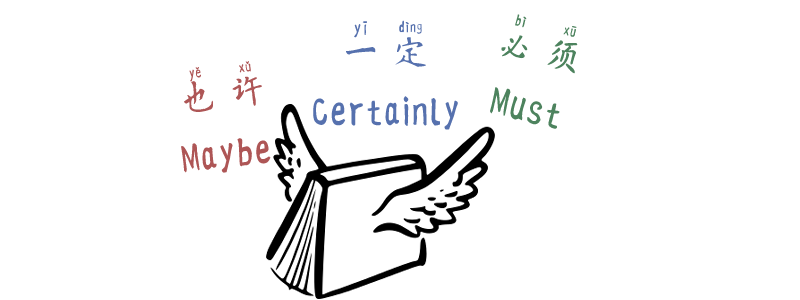
“Must”, “Certainly”, and “Maybe” in Chinese
Grammar Point:In Chinese, the translations for “must,” “certainly,” and “maybe” are 必須须 bìxū, 一定 yídìng, and 也許许 yěxǔ. But they do have some overlap parts. Structure All three of these words are adverbs in Chinese, which means they are not placed like in English where you put them before the subject or at the end…
“Still” in Chinese 1 – 还 Hái
OneDotDot Chinese Grammar · HSK 2 Grammar Point · HSK 2 還还 hái — “Still” in Chinese 1 還还 hái means “still” or “yet” — it shows that a situation or state continues, or that something hasn’t changed. 還 hái almost always comes right before the adjective or verb it modifies — and it jumps…
Day and Week in Chinese
OneDotDot Chinese Grammar · HSK 2 Grammar Point · HSK 2 Days and Weeks —天 tiān, 日 rì, 週 zhōu周 zhōu, 禮拜 lǐbài礼拜 lǐbài, 星期 xīngqí星期 xīngqī How many days? How many weeks? Counting them is simple — as long as you know which words need 個 ge个 ge. In Chinese, “day” is 日 rì…
Minutes and Hour in Chinese
OneDotDot Chinese Grammar · HSK 2 Grammar Point · HSK 2 Minutes and Hours —分鐘 fēnzhōng分钟 fēnzhōng, 小時 xiǎoshí小时 xiǎoshí, 鐘頭 zhōngtóu钟头 zhōngtóu Knowing what time it is isn’t the same as knowing how long something takes. Chinese has separate words for each. In Chinese, the words used to express durations in minutes (分鐘 fēnzhōng分钟…

“All along” in Chinese 1 – 一直 yìzhí
Grammar Point:The Chinese adverb 一直 yìzhí is used to express the idea of “continuously” or “all along” in a sentence. It indicates that an action or state has been ongoing or persistent from a certain point in time up to the present or a specified point in the future. Structure S + 一直 yìzhí +…