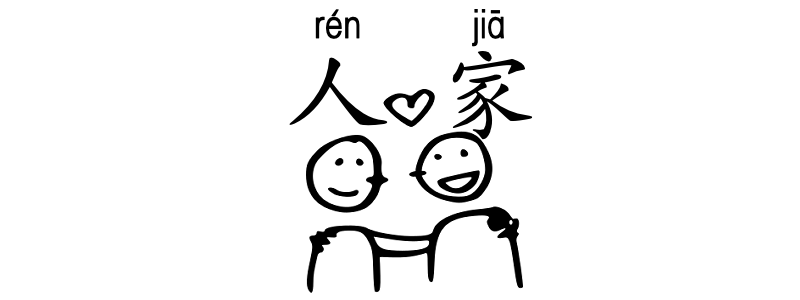
Depending on the moment, 人家 rénjiā人家 rénjia can mean “other people”, a specific “he” or “she”, the speaker themself in a cute, pouty voice — or simply a household.
1Referring to Someone Else
人家 rénjiā人家 rénjia can mean “other people” in general, or one particular person both speakers already know about — “he”, “she” or “they”. It usually carries some feeling: envy, comparison, or a gentle reminder.
人家都說沒關係了,你就別難過了。人家都说没关系了,你就别难过了。
People are saying it’s okay, so don’t be upset.
你看人家的男朋友都會送禮物,你都不會。你看人家的男朋友都会送礼物,你都不会。
Look, everyone else’s boyfriends give them gifts, but you never do.
人家愛怎麼想就怎麼想,你不用在意。人家爱怎么想就怎么想,你不用在意。
People will think what they want, you don’t have to worry about it.
你快看看人家是怎麼做的。你快看看人家是怎么做的。
Look at how others are doing it.
你要記得跟人家說謝謝喔。你要记得跟人家说谢谢喔。
Remember to thank her.
2Referring to Myself
人家 rénjiā人家 rénjia is also used in a self-referential manner, often to express humility, cuteness, or to soften a statement. It is commonly used by children or women, giving it a girly, shy, and tender feeling — you’ll hear it when children are being cute or when a girlfriend is talking to her boyfriend.
人家生氣了。人家生气了。
I am angry now.
你不要騙人家。你不要骗人家。
Don’t lie to me.
人家最近在減肥,所以不可以吃那麼多。人家最近在减肥,所以不可以吃那么多。
I’ve been trying to lose weight lately, so I can’t eat that much.
每次都我輸,人家不玩了。每次都我输,人家不玩了。
I keep losing, I don’t want to play anymore.
好羨慕你,人家都沒有錢出國。好羡慕你,人家都没有钱出国。
I envy you; I don’t have money to travel at all.
📌 Watch the Setting
Keep this usage for playful moments with family, a partner or close friends. Using it outside of these contexts might make you come across as an “angelic bitch” — what Chinese speakers call a 白蓮花白莲花 báiliánhuā, someone putting on an innocent act.
3Referring to Households
In its oldest meaning, 人家人家 rénjiā is a household or family, counted with the measure word 戶户 hù.
這個村子裡只有20戶人家。这个村子里只有20户人家。
There are only 20 households in this village.
過年時每戶人家都會在門前貼春聯。过年时每户人家都会在门前贴春联。
During New Year’s, every household puts up Spring Festival couplets on their doors.
Good to Know
In Taiwan, 人家人家 rénjiā is pronounced rénjiā in every meaning. In Mainland China, the pronoun (“others”, “he/she”, “I”) is usually read with a neutral tone — rénjia — while “household” keeps rénjiā.
4人家 rénjiā人家 rénjia vs 別人别人 biérén
Both can mean “other people”, but 人家 rénjiā人家 rénjia is more flexible and far more emotional.
| 人家 rénjiā人家 rénjia | 別人别人 biérén |
|---|
| Can point to | Others in general, one specific person (he / she), or the speaker | Others in general, or someone else — never the speaker |
| Tone | Emotional: envy, complaint, cuteness, a nudge | Neutral |
| Also means | a household (with 戶户 hù) | — |
| Example | 人家都說沒關係了 rénjiā dōu shuō méiguānxī le人家都说没关系了 rénjia dōu shuō méiguānxi le | 別人想什麼不重要别人想什么不重要 biérén xiǎng shénme bú zhòngyào |
5Common Mistakes
❌人家很希望能加入貴公司。人家很希望能加入贵公司。
✅我很希望能加入貴公司。我很希望能加入贵公司。
In a job interview or any formal setting, the cutesy self-referring 人家 rénjiā人家 rénjia sounds childish. Use 我我 wǒ.
❌這個村子有二十人家。这个村子有二十人家。
✅這個村子有二十戶人家。这个村子有二十户人家。
When 人家人家 rénjiā means “household”, a number needs the measure word 戶户 hù.
6Practice
Translate each sentence into Chinese using 人家 rénjiā人家 rénjia, then tap the card to check your answer.
01Everyone else is already done — why are you still so slow?
人家都做完了,你怎麼還這麼慢?人家都做完了,你怎么还这么慢?
👆 Tap to reveal
02It’s her birthday today — at least give her a call.
今天是人家的生日,你至少打個電話給人家吧。今天是人家的生日,你至少打个电话给人家吧。
👆 Tap to reveal
03I’m so scared — don’t leave me behind!
人家好怕,你不要丟下人家嘛。人家好怕,你不要丢下人家嘛。
👆 Tap to reveal
04I waited for you the whole afternoon!
人家等了你一個下午耶。人家等了你一个下午耶。
👆 Tap to reveal
05There are only a few households at the foot of the mountain.
山腳下只有幾戶人家。山脚下只有几户人家。
👆 Tap to reveal
06They spent a lot of time preparing — don’t criticize so casually.
人家花了很多時間準備,你別隨便批評。人家花了很多时间准备,你别随便批评。
👆 Tap to reveal
07He lent it to you — give it back to him when you’re done.
東西是人家借你的,用完要還給人家。东西是人家借你的,用完要还给人家。
👆 Tap to reveal
08That household keeps three dogs.
那戶人家養了三隻狗。那户人家养了三只狗。
👆 Tap to reveal
