家族称谓 · Chinese Vocabulary
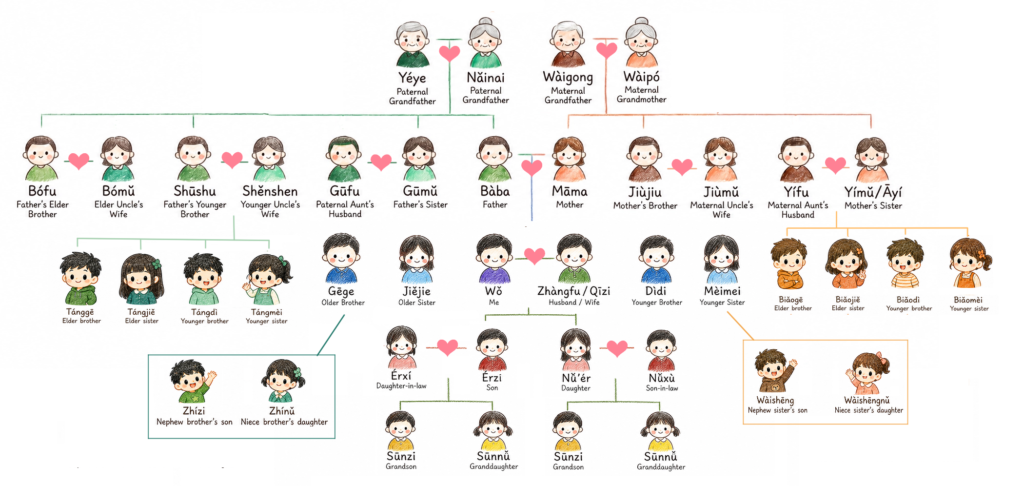
The Chinese Family Tree
家族称谓
English gets by with “aunt,” “uncle,” and “cousin.” Chinese doesn’t let you off that easy — every relative’s exact position matters: which side of the family, older or younger, by blood or by marriage. It sounds intimidating, but there’s a clear logic once you see the pattern.
The core four
核心家庭 — Immediate Family
Notice that siblings already split by age — there’s no single word for just “brother” or “sister.”
Two sides, two sets
祖父母 — Grandparents
Chinese never lets “grandma” or “grandpa” stay ambiguous — which side of the family always comes with the word.
爸爸那边 · Dad’s side
妈妈那边 · Mum’s side
现代、不分边 · Modern & side-neutral
Why “outside”?
The character 外 wài (“outside”) in 外婆 and 外公 is a leftover from when families were organized around the father’s line, treating the mother’s relatives as technically “outside” the family. Younger generations, especially in Taiwan, are moving away from that distinction — using 阿公 and 阿嬷 for grandparents on either side, no “outside” implied.
The family you make
自己的家 — Your Own Family
老公 & 老婆
老公 lǎogōng and 老婆 lǎopó are the warm, everyday way couples refer to each other — closer to “hubby” and “wifey” than the more formal 先生/太太. Despite starting with 老 (“old”), there’s nothing aging about them; it’s a term of closeness, not age.
Part two — this is where it gets serious 😵💫
Every side, precisely labeled
伯叔姑姨舅 — Aunts & Uncles
English has one “uncle” and one “aunt.” Chinese has five of each, depending on which parent they’re related to, which side of a marriage they’re on, and — for father’s brothers — whether they’re older or younger than your dad.
Uncle
Aunt
The everyday shortcut
In casual speech, especially with family friends who aren’t technically relatives, people often just say 阿姨 āyí or 叔叔 shúshu to any adult roughly their parents’ age — a polite, catch-all way to address grown-ups without working out the exact relation.
Eight ways to say “cousin”
堂表兄弟姐妹 — Cousins
Every cousin term is built from two ingredients: which side of the family (father’s = 堂, mother’s = 表), then older/younger and male/female — same pattern as siblings.
爸爸那边 · Dad’s side (堂)
妈妈那边 · Mum’s side (表)
The pattern, spelled out
Every term here is a small formula: side (堂 = dad’s side, 表 = mum’s side) + birth order (哥/姊 = older, 弟/妹 = younger). Once that clicks, you can build all eight without memorizing them one by one.
One more split
侄甥 — Nieces & Nephews
This time the split isn’t paternal/maternal — it’s whether they come from your brother’s family or your sister’s.
Brother’s side
Sister’s side
The family you marry into
姻亲 — In-Laws
Husband’s side
Wife’s side
Siblings’ side