Skip to content

OneDotDot Chinese

Learn a little Chinese every day

Menu
  • Vocabulary
  • Grammar
  • Resources
  • Practice
  • Shop
Menu

Category: HSK 1

Time in Chinese

Time in Chinese

Posted on May 23, 2023May 19, 2023 by tiffany

Grammar Point:In Mandarin Chinese, time is expressed by stating the hour first, followed by the minute, in a “big to small” order, just like in English. Time Hour + 點/点 diǎn + Minute + 分 fēn When expressing the time, you can use the structure mentioned above to indicate a specific time. However, if you…

Read more
Week of Days in Chinese

Week of Days in Chinese

Posted on May 22, 2023May 19, 2023 by tiffany

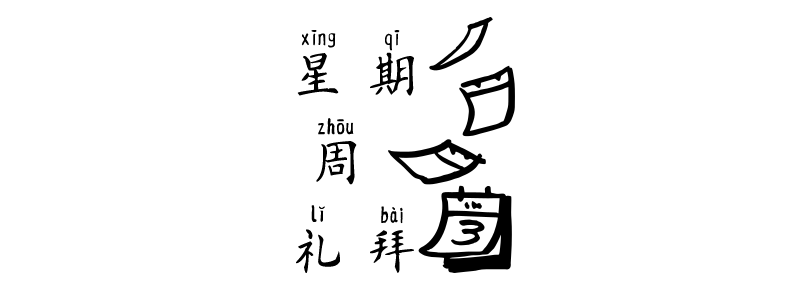
Grammar Point:In Mandarin Chinese, week of days can be expressed in three different ways, which is 星期 xīngqíqī, 禮拜礼拜 lǐbài, and 週周 zhōu. All three systems follow a simple pattern and are easy to remember! (In comparison to English😎) 星期 xīngqí/xīngqī 星期 xīngqíqī literally means “star period” and originally referred to the seven-day planetary cycle…

Read more

“Also” in Chinese – 還/还 hái and 也 yě

Posted on May 21, 2023September 6, 2026 by tiffany

OneDotDot Chinese Grammar · HSK 1 Grammar Point · HSK 1 還还 hái and 也 yě The word “also” in Chinese can be translated as 還还 hái or 也 yě. Both are commonly used to indicate inclusion or addition. Both 也 yě and 還还 hái mean “also,” but they show up in different contexts: 也…

Read more

“Don’t” in Chinese 别 bié

Posted on May 19, 2023August 12, 2026 by tiffany

“Don’t” in Chinese 別 bié — OneDotDot Chinese OneDotDot Chinese Grammar · HSK 1 Grammar Point · HSK 1 別 bié 別 bié is how Mandarin tells someone not to do something — or to stop doing something they’re already doing. The good news: 別 bié almost always works the same way — put it…

Read more
dates in Chinese

Dates in Chinese

Posted on May 18, 2023June 3, 2023 by tiffany

Grammar Point:In Mandarin Chinese, dates are expressed in the order of year, month, and day, from big to small. This is the opposite order to how dates are expressed in English. Year In Mandarin Chinese, years are typically read as a series of individual digits. However, when referring to a year period, we would read…

Read more

Chinese Numbers 1

Posted on May 17, 2023June 9, 2023 by tiffany

Grammar Point:In Chinese, numbers are typically structured in a straightforward and consistent manner. Here are the basic elements and rules for constructing Chinese numbers: Basic numerals: Chinese has a set of basic numerals that are used to represent the digits from 0 to 9. They are: 0️⃣ 1️⃣ 2️⃣ 3️⃣ 4️⃣ 零líng零líng 🔊 一yī一yī 🔊…

Read more
Chinese pronouns

Pronouns in Chinese 1

Posted on May 16, 2023May 14, 2023 by tiffany

Grammar Point:Mandarin Chinese has a relatively small number of pronouns, and unlike many European languages, there is no need to worry about subject-verb agreement. I and You 我wǒ我wǒI 我的wǒde我的wǒdemy 我wǒ我wǒme 你nǐ你nǐyou 你的nǐde你的nǐdeyour 你nǐ你nǐyou 我wǒ愛ài你nǐ我wǒ爱ài你nǐI love you. 我的wǒde狗gǒu我的wǒde狗gǒuMy dog. 我wǒ喜歡xǐhuān你的nǐde錢qián我wǒ喜欢xǐhuan你的nǐde钱qiánI like your money. Note: You may have noticed that there are two ways to say “you”…

Read more
Yes-No Questions in Chinese

Yes-No Questions in Chinese

Posted on May 15, 2023September 10, 2023 by tiffany

Grammar Point:There are six different ways to ask yes-no questions in Chinese, and the choice of which one to use can depend on factors such as location, occasion, and the people being spoken to. Structure S + V + O + 嗎/吗 ma This is the most simple and common yes-no question asking whether the…

Read more

都 dōu Grammar

Posted on May 14, 2023September 6, 2026 by tiffany

OneDotDot Chinese Grammar · HSK 1 Grammar Point · HSK 1 都 dōu 都 dōu is Chinese’s word for “all” or “both.” The good news: 都 dōu almost always works the same way — place it right after whichever noun(s) it’s summing up, whether that’s the subject or a list of objects. Just remember: a…

Read more
or in chinese haishi

Expressing “or” with 還是/还是 háishì

Posted on May 8, 2023May 5, 2023 by tiffany

Grammar Point:還是还是 háishì is a Chinese phrase that can have a few different meanings. In this article, we are going to talk about its usage in questions, where it is typically translated to “or” in English. Structure Option 1 + 還是/还是 + Option 2 你nǐ愛ài他tā還是háishì我wǒ? 你nǐ爱ài他tā还是háishì我wǒ? Who do you love, him or me? 你nǐ要yào喝hē咖啡kāfēi還是háishì茶chá? 你nǐ要yào喝hē咖啡kāfēi还是háishì茶chá?…

Read more

Posts pagination

  • Previous
  • 1
  • 2
  • 3
  • 4
  • 5
  • 6
  • 7
  • 8
  • …
  • 12
  • Next
當代中文当代中文 · Series

Contemporary Chinese

Volume Book 1 Volume Book 2 Coming Soon Book 3 Coming Soon Book 4
中文聽說讀寫中文听说读写 · Series

INTEGRATED CHINESE

Coming Soon Book 1 Coming Soon Book 2 Coming Soon Book 3 Coming Soon Book 4

OneDotDot Chinese

When a foreign friend says their Chinese is "yì diǎn diǎn" (just a little), this site exists to make that little bit grow, one day at a time.

  ABOUT

  About Me
  Special Thanks
  News
  My Students Only

  CONTACT

  LinkedIn
  Instagram
  Privacy Policy

© 2026 OneDotDot Chinese | Powered by Superbs Personal Blog theme