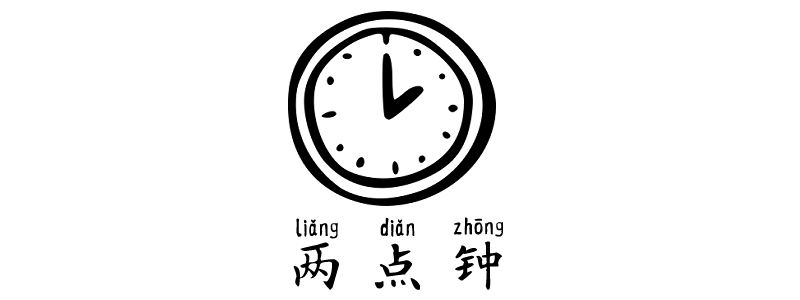
In Mandarin Chinese, time is expressed by stating the hour first, followed by the minute, in a “big to small” order, just like in English.
1Telling the Time
Hour + 點 diǎn点 diǎn + Minute + 分 fēn
Use the structure above to say a specific time. If you want to emphasize “o’clock,” add 點鐘 diǎnzhōng点钟 diǎnzhōng after the hour instead of just 點 diǎn点 diǎn.
5:50五點五十分五点五十分
five fifty
4:00四點四点 or 四點鐘四点钟
four o’clock
3:02三點零二分三点零二分
three oh two
11:01十一點零一分十一点零一分
eleven oh one
2:18兩點十八分两点十八分
two eighteen
12:15十二點十五分十二点十五分
twelve fifteen
9:00九點九点 or 九點鐘九点钟
nine o’clock
Good to Know
When the minutes are below 10, add 零 líng (“zero”) in front, just like saying “oh” in English: 三點零二分 sān diǎn líng èr fēn三点零二分 sān diǎn líng èr fēn is 3:02.
For 2 o’clock, always use 兩 liǎng两 liǎng instead of 二 èr — 兩 liǎng两 liǎng is the form used for counting hours.
In spoken Chinese, 分 fēn is often dropped to keep things short — but only when the minutes are 10 or more.
7:24七點二十四七点二十四
seven twenty-four
10:19十點十九十点十九
ten nineteen
And here is how to ask the time:
現在幾點?现在几点?
What time is it now?
2Half and Quarter — 半 bàn & 刻 kè
半 bàn — “half”
7:30七點半七点半
half past seven
12:30十二點半十二点半
half past twelve
刻 kè — “quarter”
2:15兩點一刻两点一刻
a quarter past two
8:45八點三刻八点三刻
a quarter to nine
Good to Know
刻 kè is the textbook word for “quarter,” but people in Taiwan don’t commonly use it. We prefer to say 十五分 shíwǔ fēn or 四十五分 sìshíwǔ fēn instead.
3Minutes to the Hour — 差 chā差 chà
差 chā差 chà + Minutes + 分 fēn + Hour + 點 diǎn点 diǎn
Hour + 點 diǎn点 diǎn + 差 chā差 chà + Minutes + 分 fēn
差 chā差 chà means “to be short of” or “to lack.” It tells you how many minutes are left until a certain hour, like “five to six” in English.
5:55差五分六點差五分六点
five to six
9:59十點差一分十点差一分
one minute to ten
11:28差兩分十一點半差两分十一点半
two minutes to half past eleven
4A.M. and P.M. — Times of Day
The 24-hour clock isn’t used much in everyday conversation, so you need a way to tell morning from evening. Chinese doesn’t have a direct A.M. / P.M. — instead, the day is divided into seven periods.
Key Point
These time-of-day words always go in front of the time, never after it.
| Word | Roughly | Meaning |
|---|
| 早上 zǎoshàng早上 zǎoshang | 05:00 – 09:00 | early morning |
| 上午 shàngwǔ | 09:00 – 12:00 | morning |
| 中午 zhōngwǔ | around 12:00 | noon |
| 下午 xiàwǔ | 13:00 – 18:00 | afternoon |
| 晚上 wǎnshàng晚上 wǎnshang | 18:00 – 00:00 | evening, night |
| 半夜 bànyè | 00:00 – 03:00 | midnight, the middle of the night |
| 凌晨 língchén | 03:00 – 05:00 | before dawn |
我每天早上七點起床我每天早上七点起床
I get up at 7 o’clock every morning.
晚上十一點半睡覺晚上十一点半睡觉
I go to bed at 11:30 at night.
下午三點一刻喝下午茶下午三点一刻喝下午茶
I have afternoon tea at a quarter past three.
半夜兩點不睡覺,你在做什麼?半夜两点不睡觉,你在做什么?
It’s 2 a.m. and you’re still not asleep — what are you doing?
我今天上午有中文課我今天上午有中文课
I have Chinese class this morning.
5Common Mistakes
For 2 o’clock, use 兩 liǎng两 liǎng, not 二 èr. (二 èr is still fine inside bigger numbers, like 十二點 shí’èr diǎn十二点 shí’èr diǎn for 12:00.)
❌七點早上七点早上
✅早上七點早上七点
English puts “a.m.” after the time, but Chinese goes from big to small: the time of day comes first, then the hour.
6Practice
Say each time in Chinese — don’t forget the time-of-day word! Tap the card to check your answer.
0112:00
中午十二點中午十二点
👆 Tap to reveal
0217:30
下午五點半下午五点半
👆 Tap to reveal
0303:15
凌晨三點一刻凌晨三点一刻 or 凌晨三點十五分凌晨三点十五分
👆 Tap to reveal
0408:05
早上八點零五分早上八点零五分
👆 Tap to reveal
0514:00
下午兩點下午两点
👆 Tap to reveal
0621:40
晚上九點四十分晚上九点四十分
👆 Tap to reveal
0710:55
上午十一點差五分上午十一点差五分
👆 Tap to reveal
08I have class at 9:30 tomorrow morning.
我明天上午九點半有課我明天上午九点半有课
👆 Tap to reveal
