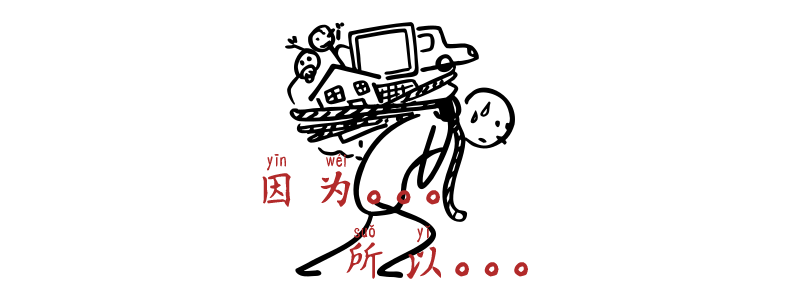
When you explain why something happened, Chinese usually states the reason first, then the result — and it likes to mark both halves with a word, even though English is happy with just “because” or just “so.”
1 Structure
因為 yīnwèi因为 yīnwèi + reason,所以 suǒyǐ所以 suǒyǐ + result — the reason always comes first, followed by the result.
因為今天天氣很好,所以我想出去玩因为今天天气很好,所以我想出去玩
Because the weather is nice today, I want to go out and play.
因為我頭痛,所以我沒有去上課因为我头疼,所以我没有去上课
Because I have a headache, I didn’t go to class.
因為外面在下雨,所以我們不能出去因为外面在下雨,所以我们不能出去
Because it’s raining outside, we can’t go out.
因為我很累,所以我想早點睡覺因为我很累,所以我想早点睡觉
Because I’m very tired, I want to sleep early.
因為我喜歡音樂,所以我常常聽歌因为我喜欢音乐,所以我常常听歌
Because I like music, I often listen to songs.
Also Worth Knowing
Unlike English, where you’d normally only say “because” or “so” in one sentence, Chinese is happy to use 因為 yīnwèi因为 yīnwèi and 所以 suǒyǐ所以 suǒyǐ together in the very same sentence — that’s the normal, expected pattern.
2 Can I Use Only 因為 yīnwèi因为 yīnwèi or 所以 suǒyǐ所以 suǒyǐ?
Yes — but it sounds casual, like something you’d only say with close friends.
Result, + 因為 yīnwèi因为 yīnwèi + Reason
Say the result first, then explain why with just 因為 yīnwèi因为 yīnwèi.
我很餓,因為我還沒吃早餐我很饿,因为我还没吃早餐
I’m hungry because I haven’t eaten breakfast yet.
我今天很開心,因為我看到朋友了我今天很开心,因为我看到朋友了
I’m happy today because I saw my friend.
我很累,因為我昨天很晚才睡我很累,因为我昨天很晚才睡
I’m tired because I didn’t go to sleep until very late yesterday.
Also Worth Knowing
You can also make this fully “correct” instead of casual, by adding 是 shì是 shì in front: 是因為 shì yīnwèi是因为 shì yīnwèi. For example, 我很餓,是因為我還沒吃早餐。Wǒ hěn è, shì yīnwèi wǒ hái méi chī zǎocān.我很饿,是因为我还没吃早餐。Wǒ hěn è, shì yīnwèi wǒ hái méi chī zǎocān.
Reason, + 所以 suǒyǐ所以 suǒyǐ + Result
Say the reason first, then just add 所以 suǒyǐ所以 suǒyǐ before the result.
下雨了,所以我們不出去了下雨了,所以我们不出去了
It’s raining, so we’re not going out.
我昨天很累,所以很早就睡了我昨天很累,所以很早就睡了
I was very tired yesterday, so I went to bed very early.
我沒有時間,所以我不能去我没有时间,所以我不能去
I don’t have time, so I can’t go.
3 Common Mistakes
When both words appear in the same sentence, the order is fixed: 因為 yīnwèi因为 yīnwèi (reason) always comes before 所以 suǒyǐ所以 suǒyǐ (result) — never the other way around. It’s also risky to drop 所以 suǒyǐ所以 suǒyǐ when you’re not just being casual.
❌
因為我頭很痛,我沒去上課因为我头很痛,我没去上课
✅
因為我頭很痛,所以我沒去上課因为我头很痛,所以我没去上课
Just like mentioned above, dropping 所以 suǒyǐ所以 suǒyǐ like this is a very casual, spoken-style shortcut — fine between close friends, but it’s considered incorrect if you’re preparing for the HSK exam. For formal writing or a test, keep 因為 yīnwèi因为 yīnwèi and 所以 suǒyǐ所以 suǒyǐ together.
4 Practice
Translate each sentence into Chinese, then tap the card to check your answer.
01Because I was sick, I didn’t go to school.
因為我生病了,所以我沒有去上學因为我生病了,所以我没有去上学
👆 Tap to reveal
02Because I forgot my umbrella, my clothes got wet.
因為我忘記帶傘,所以衣服濕了因为我忘记带伞,所以衣服湿了
👆 Tap to reveal
03I was late because the bus didn’t come.
我遲到了,因為公車沒有來我迟到了,因为公交车没有来
👆 Tap to reveal
04Because today is my friend’s birthday, I bought a cake.
因為今天是朋友的生日,所以我買了蛋糕因为今天是朋友的生日,所以我买了蛋糕
👆 Tap to reveal
05Because the weather is cold, I want to drink hot tea.
因為天氣很冷,所以我想喝熱茶因为天气很冷,所以我想喝热茶
👆 Tap to reveal
06I’m very happy because I did well on the test.
因為我考試考得很好,所以我很開心因为我考试考得很好,所以我很开心
👆 Tap to reveal
07Because he doesn’t have money, he can’t buy a new phone.
因為他沒有錢,所以他不能買新手機因为他没有钱,所以他不能买新手机
👆 Tap to reveal
08It’s already very late, so I want to go home.
已經很晚了,所以我想回家已经很晚了,所以我想回家
👆 Tap to reveal
09Because I like Chinese food, I often go to Chinese restaurants.
因為我喜歡吃中國菜,所以我常常去中式餐廳因为我喜欢吃中国菜,所以我常常去中式餐厅
👆 Tap to reveal
10I don’t have class tomorrow, so I can sleep in.
明天沒有課,所以我可以睡晚一點明天没有课,所以我可以睡晚一点
👆 Tap to reveal
