Grammar Point:因而 yīn’ér is a conjunctive adverb that means “thus,” “therefore,” or “as a result.” It indicates a causal relationship between two clauses, where the second clause is the logical consequence of the first. Structure Clause A + 因而 yīn’ér + Result of A 因而 yīn’ér is a formal, written-language equivalent of “thus” or “as a result,” used to…

Category: HSK 5
No matter how – 怎么 zěnme + 都 dōu/也 yě + neg
Grammar Point:The Chinese grammar structure “怎麼么 zěnme + 都 dōu / 也 yě + negation” is used to express “no matter how…” or “no matter what…”, emphasizing that a certain action or situation remains unchanged despite different efforts or conditions. Structure 怎麼么 zěnme + V + 都 dōu / 也 yě + Negation This pattern is often used to express…
“Moreover” in Chinese 3 – 再加上 zài jiāshang
Grammar Point:(再)加上 (zài) jiāshàang is used to introduce additional information, often emphasizing an extra reason, condition, or factor that strengthens a previous statement. It is similar to “moreover,” “besides,” “in addition,” or “on top of that” in English. Structure Statement A,(再)加上 + Statement B + Result It is used to introduce an additional reason or factor that reinforces a statement….
“Until” in Chinese – 到 dào… 为止 wéizhǐ
Grammar Point:到 dào… 為为止 wéizhǐ is a common structure for expressing ‘until’ in Chinese. Unlike English, where ‘until’ is a single word, Chinese uses 到 dào as a starting marker and 為为止 wéizhǐ as an endpoint, framing the time, condition, or event. Structure 到 dào + Time/Event/Action + (為为止 wéizhǐ) 為为止 wéizhǐ is optional, but…
Chinese Adverbs for Degree 1
Grammar Point:過於过于 guòyú, 稍微 shāowéēi, and 尤其 yóuqí are three adverbs that express degree in Chinese. They help convey different levels of intensity, slight changes, and emphasis in a sentence. Structure 過於过于 guòyú / 稍微 shāowéēi + V or Adj 稍微 shāowéēi can be used with a verb with or without 一下 yíxià or 一點点 yìdiǎn. However, adding 一下 yíxià or 一點点 yìdiǎn makes the…
“Thus” in Chinese 1 – 从而 cóng‘ér
Grammar Point:從从而 cóng’ér is a formal conjunction used to indicate a cause-and-effect or means-and-result relationship between two clauses. It can be translated as “thus,” “thereby,” or “consequently” in English. Structure Cause or method + 從从而 cóng’ér + resulting 從从而 cóng’ér is mainly used in formal writing, such as essays, reports, and news articles, to emphasize a logical result following a cause or method. While it…
Giving An Example – 拿 ná… 来说 láishuō
Grammar Point:The Chinese structure 拿 ná… 來說来说 láishuō is commonly used to give an example in conversation or writing. It can be translated as “take…for example” or “speaking of…”. Structure 拿 ná + example + 來說来说 láishuō 拿ná日本rìběn來說láishuō, 他們tāmen的de公共gōnggòng交通jiāotōng非常fēicháng準時zhǔnshí拿ná日本rìběn来说láishuō, 他们tāmen的de公共gōnggòng交通jiāotōng非常fēicháng准时zhǔnshíTake Japan, for example; their public transportation is extremely punctual. 拿ná中國Zhōngguó菜cài來說láishuō, 每個měige地區dìqū都dōu有yǒu自己zìjǐ的de特色tèsè口味kǒuwèi拿ná中国Zhōngguó菜cài来说láishuō, 每个měige地区dìqū都dōu有yǒu自己zìjǐ的de特色tèsè口味kǒuwèiTake Chinese food, for example; every…
“Sufficiently” in Chinese – 够 gòu… 的 de
Grammar Point:This structure 夠够 gòu …的 de is used to express that something is “enough to reach a certain extent” or “sufficiently.” It emphasizes the degree or extent of a quality, often to highlight how remarkable or notable something is. Structure 夠够 gòu + (S) + Adj + 的 de This pattern conveys a casual,…
“May as well” in Chinese – 也好 yěhǎo
Grammar Point:The Chinese phrase 也好 yěhǎo can mean “may as well” or “it’s fine either way”, depending on the context. Structure Option 1 + 也好 yěhǎo,Option 2 + 也好 yěhǎo This usage indicates that the speaker is indifferent or finds either option acceptable. It’s often used in casual, conversational contexts. 你nǐ去qù也好yěhǎo, 不bú去qù也好yěhǎo, 隨便suíbiàn你nǐ你nǐ去qù也好yěhǎo, 不bú去qù也好yěhǎo, 随便suíbiàn你nǐYou may as well go or…
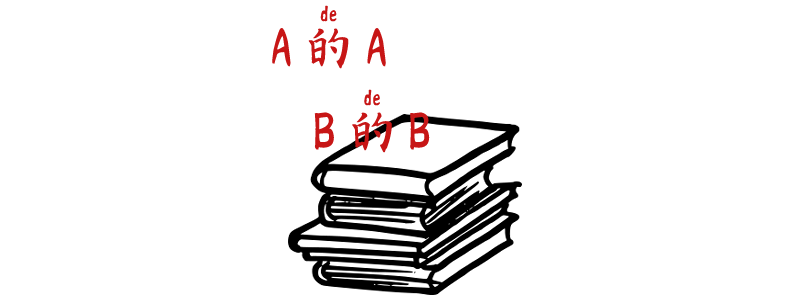
A 的 de A,B 的 de B
Grammar Point:The colloquial pattern is used to describe a situation where each person or thing has its own characteristic, role, or condition. It emphasizes the individuality or diversity within a group, often giving a sense of balance, division, or order. Structure A 的 de A,B 的 de B A refers to one group or condition,…