A field guide for learners Chinese Verbs Chinese verbs, like English ones, fall into three broad categories: the verb 是是 shì (“to be”), the verb 有有 yǒu (“to have”), and the broad remaining set of action verbs. Some teachers argue for a fourth category, treating Chinese adjectives as stative verbs. The baseline The Verb Does…
Author: tiffany
The Passive Sentence 4 (Advanced)
OneDotDot Chinese Grammar · HSK 7-9 Grammar Point · HSK 7-9 被 bèi被 bèi / 為 wéi为 wéi ⋯ 所 suǒ所 suǒ ⋯ — The Passive Sentence 4 This is the most formal shape a Chinese passive sentence can take — the kind you’d hear in a speech or read in an official document, not…
就 vs 才
就 · 才 — 近義詞辨析 Similar words 就jiù · 才cái Two tiny words that quietly carry a speaker’s sense of timing, expectation, and attitude — and change the whole feel of a sentence. 就jiù and 才cái can each show up in several completely different grammar patterns, and in almost every one of them they sit…
The functions of 把 bǎ 3
OneDotDot Chinese Grammar · HSK 5 Grammar Point · HSK 5 把 bǎ把 bǎ — 把 Sentence 3 Two structures that bend the usual 把 bǎ把 bǎ rules a little:one borrowed from “as soon as,” and one where the verb takes two objects at once. Both are common in everyday speech, even though they look…
Degree complements 3
OneDotDot Chinese Grammar · HSK 5 Grammar Point · HSK 5 程度補語程度补语 chéngdù bǔyǔ — Degree Complement 3 One level up from 死了死了 sǐle and 厲害厉害 lìhài: 得得 de + 不得了不得了 bùdéliǎo pushes the intensity even further — literally “unbearable,” used for something so extreme it’s hard to contain. Structure: Adjective / Psychological Verb +…
Stative verbs (adj.)
A field guide for learners Chinese Stative Verbs What English treats as adjectives, Chinese treats as a special kind of verb — one that describes a mood, the weather, an appearance, or a quality, without ever needing “to be” alongside it. The concept What Is a Stative Verb? Stative verbs — also called Chinese adjectives…
The functions of 把 bǎ 4
OneDotDot Chinese Grammar · HSK 6 Grammar Point · HSK 6 把 bǎ把 bǎ — 把 Sentence 4 Two more advanced shapes:one where the subject isn’t even a person — a sound, a smell, a pair of shoes — and one where the “other elements” get much richer, describing degree or reframing what something’s seen…
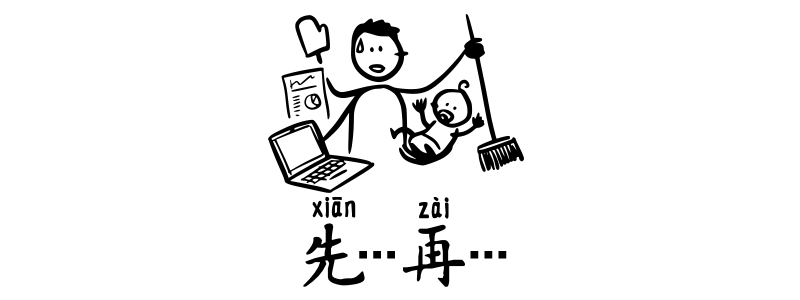
Expressing the Order in Chinese
Grammar Point:To express the order of several actions can involve many different options in Chinese, but the basic structure is 先 xiān… 再 zài…, which can translate into first… and then… in English. Basic Structure S1 + 先… + S2 + 再… When both subjects are the same, it is ok to drop the S2….
有 Yǒu Sentence 2
OneDotDot Chinese Grammar · HSK 2 Grammar Point · HSK 2 有 yǒu — Estimating & Comparing Beyond possession and existence, 有 yǒu有 yǒu can also express reaching or attaining a certain degree. It’s used both to give a rough estimate of a number, and to build comparative sentences. The 有字句 yǒuzìjù有字句 yǒuzìjù continues here…
Quantity Complements 1
OneDotDot Chinese Grammar · HSK 1 Grammar Point · HSK 1 數量補語数量补语 shùliàng bǔyǔ — Quantity Complement 1 When you want to say how many times you’ve done something, Chinese adds a little word right after the verb — a quantity complement. This part covers 次次 cì and 遍遍 biàn, the two most common ones….