Grammar Point:In Chinese, the structures 在 zài··· 看来 kànlái and 从 cóng··· 来看 láikàn are commonly used to express a viewpoint. They can be translated as “in someone’s opinion” or “judging from a certain perspective.” Structure 在 + Somebody + 看來来 + Commentary This structure translates to “in someone’s opinion” or “from someone’s perspective.” It highlights a subjective…
Author: tiffany
Only if in Chinese 2 – 除非 chúfēi… 才 cái…
OneDotDot Chinese Grammar · HSK 6 Grammar Point · HSK 6 除非除非 chúfēi… 才才 cái… 除非除非 chúfēi still sets up the one exception, but instead of warning what happens if it doesn’t come true, 才才 cái marks the result as something that only becomes possible once that exception is met — this is the “Only…
Unless in Chinese
OneDotDot Chinese Grammar · HSK 6 Grammar Point · HSK 6 除非除非 chúfēi…否則否则 fǒuzé… 除非除非 chúfēi sets up the one exception that changes everything, then 否則否则 fǒuzé, 不然不然 bùrán, or 要不然要不然 yàobùrán delivers the consequence if that exception doesn’t happen — together they build the Chinese “unless A, otherwise B” structure. Unlike English, where “otherwise”…
Even If in Chinese 3
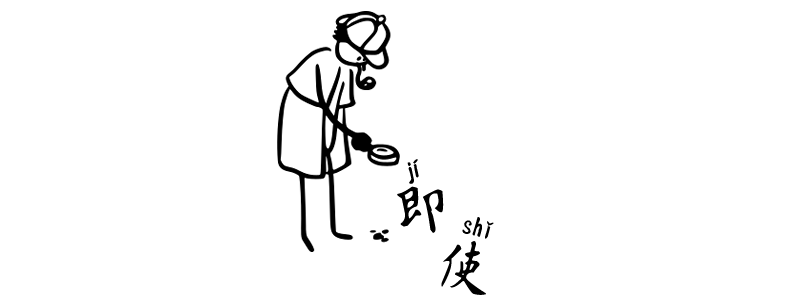
Grammar Point:To express even if in Chinese, we need to use 即使 jíshǐ or 哪怕 nǎpà and usually followed by the second clause 也 yě. In this pattern, the first clause is a supposition, which is then struck down as impossible by the statement’s second clause. Structure 即使 + ···,也 + ··· Subject 1 can…
有 Yǒu Sentence 3
OneDotDot Chinese Grammar · HSK 5 Grammar Point · HSK 5 有 yǒu — Attachment & Lasting Existence At the advanced level, 有 yǒu有 yǒu takes on two more literary, descriptive jobs: showing that something exists or is held in an ongoing, lasting way , and showing that something is physically attached to or inscribed…
有 yǒu Sentence 1
OneDotDot Chinese Grammar · HSK 1 Grammar Point · HSK 1 有 yǒu — “To Have, There Is” The “you sentence,” known as 有字句 yǒuzìjù有字句 yǒuzìjù in Chinese, is built around the word 有 yǒu有 yǒu. This article covers its three most basic jobs: possession (“to have”), existence at a place (“there is/are”), and introducing…
“Once” in Chinese 2 – yídàn
OneDotDot Chinese Grammar · HSK 5 Grammar Point · HSK 5 一旦一旦 yídàn — “Once” The structure 一旦一旦 yídàn⋯就就 jiù⋯ is often used in Chinese to express “once.” In this pattern, 就 jiù serves as a condition marker and can be translated as “then” or “in that case.” This structure indicates that once a certain…
Although in Chinese
Grammar Point:Although 雖虽然, suīrán and but 但是, dànshì can both be translated as ‘although’ and ‘but,’ in English, you wouldn’t use ‘but’ in the same sentence as ‘although.’ In Chinese, however, ‘although’ and ‘but’ are often used together, especially in written text. Structure 雖然/虽然 ······,但是 or 可是 ······ Think of ‘although’ and ‘but’ as a…
Degree complements 4
OneDotDot Chinese Grammar · HSK 6 Grammar Point · HSK 6 程度補語程度补语 chéngdù bǔyǔ — Degree Complement 4 The last stop on the degree ladder: 透了透了 tòule, plus a handful of colloquial cousins — 不行不行 bùxíng, 要命要命 yàomìng/要死要死 yàosǐ, and 個不停个不停 ge bùtíng — that native speakers reach for at the most extreme end of…
Quantity Complements 3
OneDotDot Chinese Grammar · HSK 3 Grammar Point · HSK 3 數量補語数量补语 shùliàng bǔyǔ — Quantity Complement 3 Some verbs — 結婚结婚 jiéhūn (get married), 認識认识 rènshi (get to know), 離開离开 líkāi (leave) — happen in a single instant, not over a stretch of time. For these, the same “V+time” pattern says something different: how…