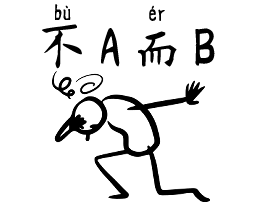
不 + V1(the expected step) + 而 + V2(the actual, surprising outcome) — that’s the whole formula. It’s compact classical grammar, frozen almost entirely into fixed idioms rather than living on as something you freely build new sentences with.
That’s also the trap: because the formula is so transparent, it’s tempting to invent your own combination. Native speakers won’t hear a home-made “不X而Y” as clever wordplay — they’ll just hear a mistake.
1 Structure
The Formula: 不 + V1 + 而 + V2
V1 is a step you’d normally expect to happen first; V2 is the outcome that happened anyway, without it. The whole four-character unit usually functions as the predicate or an adverbial in the sentence.
執行長即將請辭的消息,不脛而走,令全體員工議論紛紛执行长即将请辞的消息,不胫而走,令全体员工议论纷纷
News that the CEO was about to resign spread like wildfire, without anyone deliberately spreading it — sparking discussion among all employees.
走 zǒu (走路 zǒulù/傳開传开 chuánkāi) happened without 脛胫 jìng (legs) — i.e. without deliberate promotion.
這項福利政策若設計不當,恐怕會助長不勞而獲的心態这项福利政策若设计不当,恐怕会助长不劳而获的心态
If this welfare policy is poorly designed, it risks fostering a mentality of getting something for nothing.
獲获 huò (gaining) happened without 勞劳 láo (labour).
A Family of Everyday Idioms
Once you know the shape, you’ll spot it everywhere. Here are a few more members of the family.
這項計畫的重要性,早已不言而喻这项计划的重要性,早已不言而喻
The importance of this plan has long gone without saying.
回想起當時的險境,他至今仍感到不寒而慄回想起当时的险境,他至今仍感到不寒而栗
Recalling the dangerous situation at the time, he still shudders even now.
她留下一張字條後,便不辭而別,沒有人知道她的去向她留下一张字条后,便不辞而别,没有人知道她的去向
She left a note, then departed without saying goodbye — no one knew where she’d gone.
兩位學者雖然來自不同領域,對這項議題的看法卻不謀而合两位学者虽然来自不同领域,对这项议题的看法却不谋而合
Though the two scholars come from different fields, their views on this issue coincided without any prior discussion.
Bonus: More of the Family
不宣而戰 bùxuānérzhàn不宣而战 bùxuānérzhàn — launch an attack (or, in business journalism, a competitive move) without a formal declaration. 不藥而癒 bùyàoéryù不药而愈 bùyàoéryù — recover without any medication. 不教而誅 bùjiàoérzhū不教而诛 bùjiàoérzhū — punish someone who was never warned or taught better first.
2 Common Mistakes
Both mistakes come from treating this classical shape as more flexible than it really is.
❌
他的心意,我不看而知他的心意,我不看而知
✅
他的心意,我不用看就知道他的心意,我不用看就知道
不A而B isn’t a freely productive formula in modern Chinese — it survives only in a closed set of inherited idioms. Coining a new combination like 不看而知 won’t read as clever; it just sounds like an error. Stick to a real 成語, or plain phrasing.
❌
他們不謀而合地鼓掌他们不谋而合地鼓掌
✅
他們不約而同地鼓掌他们不约而同地鼓掌
不謀而合 bùmóuérhé describes matching ideas, opinions, or plans — not a shared physical action happening at the same moment. For people doing the same thing at once without prior arrangement, 不約而同 bùyuēértóng (usually with 地 de + verb) is the right choice.
3 不謀而合不谋而合 vs 不約而同不约而同 vs 不期而遇不期而遇
Three idioms from the same family, all about things lining up without prior arrangement — but not interchangeable.
|
不謀而合不谋而合
bùmóuérhé |
不約而同不约而同
bùyuē’értóng |
不期而遇不期而遇
bùqīéryù |
| Picture |
Two parties’ ideas, plans, or judgments align without ever having discussed them |
Two or more people take the same action, or react the same way, at the same moment |
People run into each other by chance, with no arrangement to meet |
| Subject |
Opinions, strategies, conclusions |
People’s actions or reactions |
People (an encounter) |
| Position |
Usually the main predicate — A與B的看法不謀而合 |
Adverbial before a verb — 大家不約而同地 + V |
Main predicate describing a meeting |
| Tone |
Neutral to positive; occasionally ironic if the aligned plans are unsavoury |
Positive, communal — a pleasant surprise of shared reaction |
Positive, often nostalgic or fateful-feeling |
Little secret
All three describe something lining up “by coincidence” — which is exactly why learners mix them up. The fastest fix: ask what’s doing the lining-up. Ideas → 不謀而合不谋而合. Actions → 不約而同不约而同. People themselves → 不期而遇不期而遇.
4 Practice
Translate each sentence into Chinese, then tap the card to check your answer.
01The rumor that the merger had fallen through spread like wildfire across the industry.
併購破局的傳聞,在業界不脛而走并购破局的传闻,在业界不胫而走
👆 Tap to reveal
02Without any prior communication, the two research teams’ conclusions coincided exactly.
兩個研究團隊事先毫無溝通,結論卻不謀而合两个研究团队事先毫无沟通,结论却不谋而合
👆 Tap to reveal
03When the results were announced, everyone in the room gasped in unison.
結果公布時,全場的人不約而同地倒抽一口氣结果公布时,全场的人不约而同地倒抽一口气
👆 Tap to reveal
04Relying on insider information to profit is essentially getting something for nothing.
靠內線消息獲利,本質上就是一種不勞而獲靠内线消息获利,本质上就是一种不劳而获
👆 Tap to reveal
05Given how thoroughly he prepared, his eventual promotion goes without saying.
以他準備的周全程度來看,他日後升遷早已不言而喻以他准备的周全程度来看,他日后升迁早已不言而喻
👆 Tap to reveal
06Even years later, recalling that near-miss on the highway still makes her shudder.
即使過了多年,回想起那次高速公路上的驚險瞬間,她仍不寒而慄即使过了多年,回想起那次高速公路上的惊险瞬间,她仍不寒而栗
👆 Tap to reveal
07He left the company without any formal resignation, leaving his colleagues bewildered.
他不辭而別地離開公司,讓同事們一頭霧水他不辞而别地离开公司,让同事们一头雾水
👆 Tap to reveal
08The two old classmates ran into each other by chance at a conference overseas.
兩位老同學在海外的一場研討會上不期而遇两位老同学在海外的一场研讨会上不期而遇
👆 Tap to reveal
09The company launched the product without any formal announcement, catching competitors off guard.
公司不宣而戰地推出新產品,讓競爭對手措手不及公司不宣而战地推出新产品,让竞争对手措手不及
👆 Tap to reveal
10His recovery without any medication surprised the entire medical team.
他不藥而癒的恢復,讓整個醫療團隊都感到驚訝他不药而愈的恢复,让整个医疗团队都感到惊讶
👆 Tap to reveal
