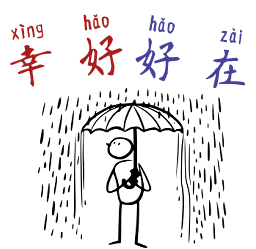
Compared with 幸虧 xìngkuī幸亏 xìngkuī, which usually points to a fortunate action someone took in the moment, 好在 hǎozài好在 hǎozài points to something that was already true — a location, an existing backup plan, a structure built to code.
幸好 xìnghǎo幸好 xìnghǎo sits comfortably in between — it doesn’t care whether the lucky factor was an action or a pre-existing state, which is exactly why it’s the one you’ll hear most often.
1 Structure
幸好 xìnghǎo幸好 xìnghǎo + Lucky Incident,(要不然/不然/否則 yàobùrán/bùrán/fǒuzé要不然/不然/否则 yàobùrán/bùrán/fǒuzé) + Negative Result
Unlike 幸虧 xìngkuī幸亏 xìngkuī, 幸好 xìnghǎo幸好 xìnghǎo can sit before OR after the subject. Placing it after the subject puts more emphasis on that subject’s role in the lucky escape. The “otherwise” clause is common but, unlike with 幸虧幸亏, often optional — the situation can simply be left as a stated relief.
幸好委員會臨時提出異議,這項法案才沒有倉促通過幸好委员会临时提出异议,这项法案才没有仓促通过
Fortunately the committee raised an objection at the last minute; otherwise this bill would have passed hastily.
幸好 before the subject (委員會) — the default, neutral position.
這場投資,我幸好及時抽身,否則損失恐怕難以估計这场投资,我幸好及时抽身,否则损失恐怕难以估计
In this investment, I fortunately withdrew in time — otherwise the losses would have been hard to estimate.
幸好 after the subject (我) — puts emphasis on “I” specifically.
好在 hǎozài好在 hǎozài + Pre-existing Favourable Condition
好在 hǎozài好在 hǎozài only ever goes before the subject. It typically follows a sentence describing a difficult situation, then introduces the redeeming factor — something that was already true, not an action anyone took in the moment.
這次颱風來得又急又猛,好在這棟建築物本身結構穩固,並未受到嚴重損害这次台风来得又急又猛,好在这栋建筑物本身结构稳固,并未受到严重损害
This typhoon hit both suddenly and fiercely; fortunately the building’s structure was inherently sturdy, so it wasn’t seriously damaged.
The sturdy structure already existed — it wasn’t a lucky action taken during the storm.
這條供應鏈一度中斷,好在我們原本就有備援廠商,才沒有影響出貨这条供应链一度中断,好在我们原本就有备援厂商,才没有影响出货
The supply chain was interrupted at one point; fortunately we already had a backup supplier, so shipments weren’t affected.
原本就有 (“already had”) signals the pre-existing condition that 好在 wants.
Bonus: 還好 háihǎo还好 háihǎo
A close colloquial cousin of 幸好幸好, largely interchangeable with it — the one you’ll hear most in everyday chat.
還好我有先訂位,不然今天肯定要等很久还好我有先订位,不然今天肯定要等很久
Good thing I made a reservation — otherwise we’d definitely have had to wait forever today.
2 Common Mistakes
The two trip learners up in different ways — one is about position, the other about what kind of “luck” is being described.
❌
我們好在來得早,才買到票我们好在来得早,才买到票
✅
好在我們來得早,才買到票好在我们来得早,才买到票
好在好在 only goes before the subject — it can’t follow it the way 幸好幸好 can (我們幸好來得早我们幸好来得早 would be fine).
❌
好在他及時煞車,才沒有出車禍好在他及时刹车,才没有出车祸
✅
幸好他及時煞車,才沒有出車禍幸好他及时刹车,才没有出车祸
煞車刹车 (“braking”) is an action taken in the moment, not a condition that already existed. 好在好在 wants a pre-existing advantage; for a spontaneous lucky action, 幸好幸好 or 幸虧幸亏 fits better.
3 幸好幸好 vs 好在好在 vs 幸虧幸亏
A quick side-by-side of the three “fortunately” words.
|
幸好 xìnghǎo幸好 xìnghǎo |
好在 hǎozài好在 hǎozài |
幸虧 xìngkuī幸亏 xìngkuī |
| Picture |
Any stroke of luck — action or pre-existing condition alike |
Specifically a pre-existing, already-there favourable condition |
A fortunate action or event that narrowly averted disaster |
| Position |
Flexible — before or after the subject |
Topic-initial only — always before the subject |
Must combine with a full clause, sentence-initial |
| Tone |
Neutral relief — the default, most frequent choice |
Milder relief; can double as a “silver lining” connector |
Stronger emphasis, often implies a narrower escape |
| Register |
Spoken and written, most common overall |
More written/reflective; less frequent than 幸好 |
Spoken and written, common in narrative |
Little secret
Honestly? To a lot of native speakers, these three feel basically identical — which one comes out of their mouth is mostly just personal habit, not a conscious choice between “action vs. pre-existing condition.” Real speech is messier than any table.
But for the HSK, you don’t get that luxury — the exam expects you to know exactly which one fits which slot, so the distinctions above are worth actually locking in.
4 Practice
Translate each sentence into Chinese, then tap the card to check your answer.
01Fortunately the auditor discovered the discrepancy before the report was published.
幸好稽核人員在報告發布前發現了差異幸好稽核人员在报告发布前发现了差异
👆 Tap to reveal
02This neighborhood floods easily, but fortunately the drainage system was upgraded years ago. (pre-existing condition)
這個社區容易淹水,好在排水系統多年前就已經升級了这个社区容易淹水,好在排水系统多年前就已经升级了
👆 Tap to reveal
03The negotiations nearly collapsed; fortunately, I stepped in in time. (幸好 after subject)
這場談判差點破裂,我幸好及時介入这场谈判差点破裂,我幸好及时介入
👆 Tap to reveal
04The bridge was badly damaged in the earthquake; fortunately it had already been reinforced to the latest seismic standard. (pre-existing condition)
這座橋在地震中受損嚴重,好在它事先按照最新的抗震標準加固過这座桥在地震中受损严重,好在它事先按照最新的抗震标准加固过
👆 Tap to reveal
05Fortunately the backup generator kicked in immediately; otherwise the whole hospital would have lost power.
幸好備用發電機立刻啟動,要不然整間醫院就會停電幸好备用发电机立刻启动,要不然整间医院就会停电
👆 Tap to reveal
06The crash nearly wiped out our savings; fortunately we had already diversified our portfolio. (pre-existing condition)
這波崩盤幾乎讓我們血本無歸,好在我們事先分散了投資組合这波崩盘几乎让我们血本无归,好在我们事先分散了投资组合
👆 Tap to reveal
07Fortunately the witness came forward before the trial ended.
幸好證人在審判結束前挺身而出幸好证人在审判结束前挺身而出
👆 Tap to reveal
08The factory’s main power line failed; fortunately a backup circuit was already in place. (pre-existing condition)
工廠的主電路故障了,好在早就設有備用線路工厂的主电路故障了,好在早就设有备用线路
👆 Tap to reveal
09Fortunately the captain acted decisively; otherwise the ship would have run aground.
幸好船長當機立斷,不然這艘船就會擱淺幸好船长当机立断,不然这艘船就会搁浅
👆 Tap to reveal
10The company’s stock plunged overnight; fortunately its cash reserves were already substantial, so it wasn’t forced into layoffs. (pre-existing condition)
公司股價一夜暴跌,好在現金儲備原本就相當充裕,才不至於被迫裁員公司股价一夜暴跌,好在现金储备原本就相当充裕,才不至于被迫裁员
👆 Tap to reveal
