Skip to content

OneDotDot Chinese

Learn a little Chinese every day

Menu
  • Vocabulary
  • Grammar
  • Resources
  • Practice
  • Shop
Menu

Moving on an Object with 把 bǎ

Posted on April 18, 2025October 26, 2026 by tiffany

Table of Contents

Toggle
  • 一 What Is 把 For?
  • 二 把 + O + V + 在 / 到 + Place
  • 三 把 + O + V + 給给 + Person
  • 四 把 + O + V + Result Complement
  • 五 把 + O + V + Directional Complement
  • 六 Common Mistakes
  • 七 Practice

  • Text Display
  • ►Traditional
  • ►Simplified
  • Pinyin Display
  • ►Visible
  • ►Mouseover
  • ►Hidden
Grammar Point

Moving an Object with 把 bǎ

當代中文2 Contemporary Chinese 2

把 bǎ can’t be translated into English, which is why many learners avoid it. But native speakers use it all the time! It moves a known object to the front, so the verb can come at the end and tell you what happened to that object: where it went, who got it, or how it changed.

一 What Is 把 For?

Subject + 把 + Object + Verb + Something

Normal Chinese word order is Subject + Verb + Object. With 把 bǎ, it becomes Subject + 把 bǎ + Object + Verb + something. Moving the object forward turns “an object” into “the object,” and leaves room after the verb to explain the result.

We usually use 把 bǎ to express:

  • Determination (often with “I”): I’m going to do something to it.
  • A command (often with “you”): instructions, moving things, decorating…
  • An action that changes a known object: the most common use.
Before we startFour rules before you start:
1. The object must be something both speakers know (this / that / my…).
2. No feeling verbs: love, like, hate, miss, feel…
3. The verb always needs something after it.
4. Negatives and adverbs go before 把 bǎ.

That “something” can be a result complement (完, 開开, 得…), a directional complement (進去进去, 出來出来…), a quantity complement (一次, 十遍…), the special verbs 在 · 到 · 給给 · 成, or a short-time form (V了V, V一V, V一下). In this lesson we focus on four of them.

二 把 + O + V + 在 / 到 + Place

S + 把 + O + Verb + 在 / 到 + Place

Use this to say where the object ends up. 在 zài focuses on the object being in a place (common verbs: 放 fàng put, 掛 guà挂 guà hang, 收 shōu put away). 到 dào usually involves a movement to get it there.
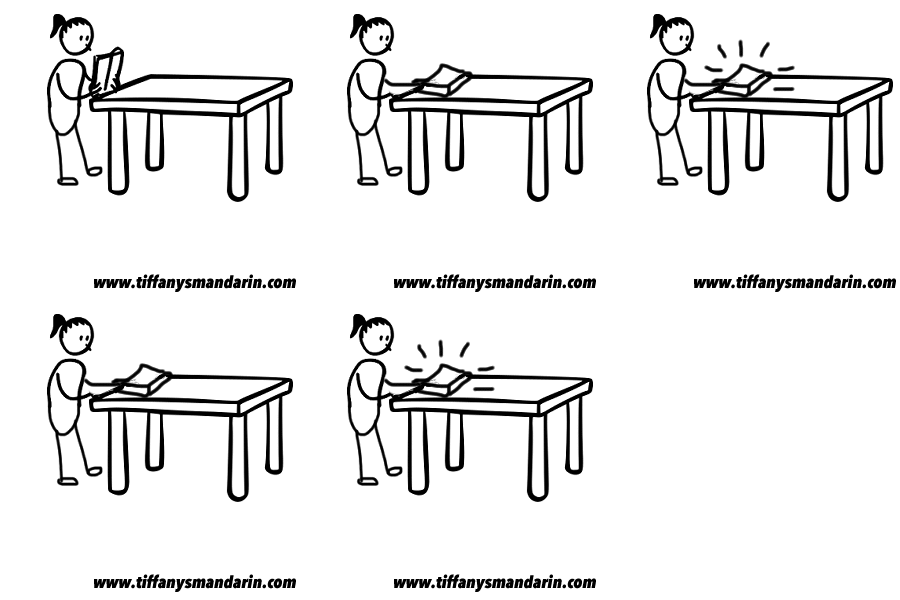
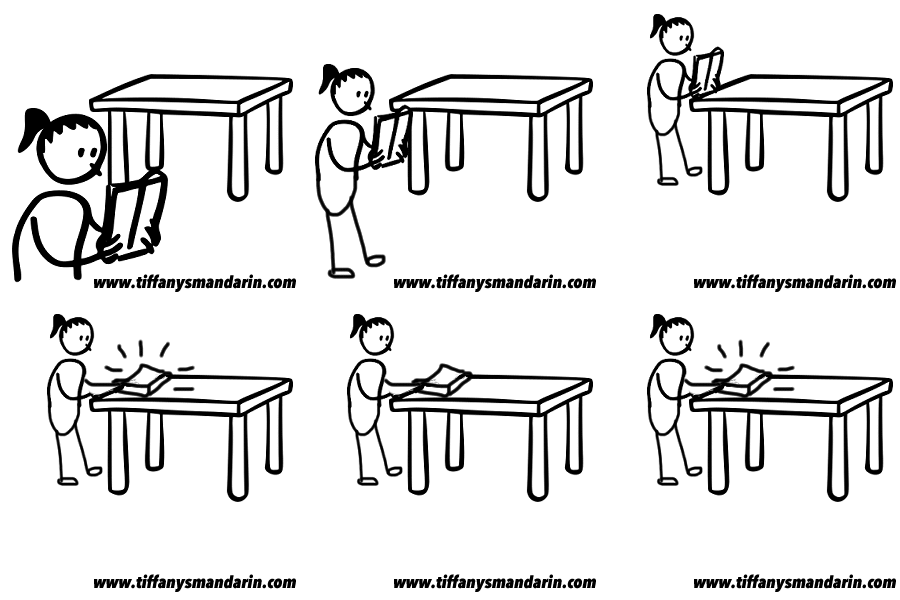
妹妹mèimei把bǎ書shū书shū放fàng在zài桌子zhuōzi上shàng
My younger sister put the book on the table.
The book now is on the table.
妹妹mèimei把bǎ書shū书shū放fàng到dào桌子zhuōzi上shàng
My younger sister moved the book onto the table.
Focus on the movement that gets it there.
你nǐ不能bùnéng把bǎ車chē车chē停tíng到dào公司gōngsī前面qiánmiàn
You can’t park your car in front of the office.
A command.
我wǒ應該yīnggāi应该yīnggāi現在xiànzài现在xiànzài把bǎ東西dōngxī东西dōngxi寄jì到dào美國Měiguó美国Měiguó嗎ma吗ma?
Should I mail my stuff to the US now?

三 把 + O + V + 給给 + Person

S + 把 + O + Verb + 給给 + Person

Use this for handing something over to someone. Common verbs: 送 sòng give, 拿 ná take, 遞 dì递 dì pass, 賣 mài卖 mài sell, 借 jiè lend, 還 huán还 huán return, 介紹 jièshào介绍 jièshào introduce, 寄 jì mail.

爺爺yéye爷爷yéye把bǎ新xīn買mǎi买mǎi的de玩具wánjù送sòng給gěi给gěi了le妹妹mèimei
Grandpa gave the new toy he bought to my sister.
我wǒ不bù想xiǎng把bǎ禮物lǐwù礼物lǐwù拿ná給gěi给gěi他tā
I don’t want to give him the present.
Determination. Notice 不 goes before 把.
我wǒ真的zhēnde不bù該gāi该gāi把bǎ錢qián钱qián借jiè給gěi给gěi朋友péngyǒu朋友péngyou
I really shouldn’t have lent money to my friend.

四 把 + O + V + Result Complement

S + 把 + O + Verb + Result Complement

The complement after the verb shows the result: finished, opened, cleaned…

你nǐ快kuài把bǎ藥yào药yào吃完chīwán
Hurry up and finish your medicine.
A command.
誰shéi谁shéi把bǎ我wǒ的de信xìn打開dǎkāi打开dǎkāi了le?
Who opened my letter?
媽媽māma妈妈māma把bǎ衣服yīfú衣服yīfu洗xǐ得de非常fēicháng乾淨gānjìng干净gānjìng
Mom got the clothes really clean.

五 把 + O + V + Directional Complement

S + 把 + O + Verb + Directional Complement

A directional complement shows which direction the object moves: off, out, down…

孩子háizi把bǎ褲子kùzi裤子kùzi脫tuō脱tuō下來xiàlái下来xiàlai
The child took his pants off.
把bǎ錢qián钱qián全部quánbù拿ná出來chūlái出来chūlai
Take out all the money!
A command.
你nǐ等一下děng yíxià記得jìdé记得jìde把bǎ垃圾lèsè垃圾lājī拿ná下去xiàqù下去xiàqu
Remember to take the trash down in a bit.
Taiwan vs. mainland“Trash” 垃圾 is pronounced lèsè in Taiwan and lājī in mainland China.

六 Common Mistakes

❌ 我wǒ把bǎ咖啡kāfēi喝hē在zài咖啡店kāfēidiàn

✅ 我wǒ在zài咖啡店kāfēidiàn喝hē咖啡kāfēi

Drinking the coffee doesn’t make the coffee end up in the café. Use 在 zài + place before the verb.

❌ 請qǐng请qǐng你nǐ把bǎ一yì杯bēi水shuǐ拿ná給gěi给gěi我wǒ

✅ 請qǐng请qǐng你nǐ把bǎ那nà杯bēi水shuǐ拿ná給gěi给gěi我wǒ

“A glass of water” isn’t something both speakers know. Use “that,” “my,” or something similar.

❌ 我wǒ把bǎ他tā愛ài爱ài了le

✅ 我wǒ愛ài爱ài他tā

Feelings can’t be used with 把 bǎ.

❌ 哥哥gēge把bǎ筆bǐ笔bǐ不bù放fàng在zài桌zhuō上shàng

✅ 哥哥gēge不bù把bǎ筆bǐ笔bǐ放fàng在zài桌zhuō上shàng

All negatives and adverbs go before 把 bǎ.

七 Practice

Tap the words below in the right order to build the sentence, then check your answer. If it’s wrong, you can try again as many times as you like, or hit “Show answer” if you get stuck. Careful: some tiles are traps and are not needed!

Question 1 of 10

“Put the keys on the table.”

Tap words below to build the sentence

❌ Try Again

把bǎ鑰匙yàoshi钥匙yàoshi放fàng在zài桌子zhuōzi上shàng

Starting with 你 nǐ is also correct.

A command: 把 bǎ + object + V + 在 + place.

“I gave the book to my sister.”

Tap words below to build the sentence

❌ Try Again

我wǒ把bǎ書shū书shū送sòng給gěi给gěi妹妹mèimei了le

Putting 了 right after 送給送给 is also correct.

Handing it over → V + 給给 + person.

“Who ate my cake?”

Tap words below to build the sentence

❌ Try Again

誰shéi谁shéi把bǎ我wǒ的de蛋糕dàngāo吃chī了le?

The verb needs something after it, so 吃 chī alone is a trap. 🍰

“Please close the door.”

Tap words below to build the sentence

❌ Try Again

請qǐng请qǐng把bǎ門mén门mén關上guānshàng关上guānshang

關 guān关 guān alone has nothing after it, so it’s not enough.

“Take the trash out.”

Tap words below to build the sentence

❌ Try Again

把bǎ垃圾lèsè垃圾lājī拿ná出去chūqù出去chūqu

Starting with 你 nǐ is also correct.

V + directional complement.

“I finished my homework.”

Tap words below to build the sentence

❌ Try Again

我wǒ把bǎ功課gōngkè作业zuòyè寫完xiěwán写完xiěwán了le

V + result complement 完 wán.

“Don’t put your phone on the bed.”

Tap words below to build the sentence

❌ Try Again

不要búyào把bǎ手機shǒujī手机shǒujī放fàng在zài床chuáng上shàng

不要 búyào goes before 把 bǎ.

“He mailed the package to Japan.”

Tap words below to build the sentence

❌ Try Again

他tā把bǎ包裹bāoguǒ寄jì到dào日本Rìběn了le

Leaving out 了 is also correct.

A movement to a place → V + 到 dào.

“I love him very much.”

Tap words below to build the sentence

❌ Try Again

我wǒ很hěn愛ài爱ài他tā

Feelings can’t use 把 bǎ, so it’s a trap. ❤️

“Please pass me that cup of coffee.”

Tap words below to build the sentence

❌ Try Again

請qǐng请qǐng把bǎ那nà杯bēi咖啡kāfēi拿ná給gěi给gěi我wǒ

The object must be known: “that cup,” not “a cup.”

Related Grammar

→Resultant Location with Verb + 在 zàiGrammar
→把 bǎ Part 2HSK 4
→把 bǎ Part 3HSK 5
→把 bǎ Part 4HSK 6
→Advanced 把 bǎ Part 5HSK 7-9
→Use 把 bǎ or Not? PracticePractice
Do you like it? :)

1 thought on “Moving on an Object with 把 bǎ”

  1. Pingback: Direction Complement with 把 bǎ - OneDotDot Chinese

Comments are closed.

Level Checker

Free tool for HSK Check a text → Free tool for TOCFL Check a text →

Free Level Test

10 min · No sign-up Start the HSK TEST → 10 min · No sign-up Start the TOCFL TEST →
當代中文当代中文 · Series

Contemporary Chinese

Volume Book 1 Volume Book 2 Coming Soon Book 3 Coming Soon Book 4
中文聽說讀寫中文听说读写 · Series

INTEGRATED CHINESE

Coming Soon Book 1 Coming Soon Book 2 Coming Soon Book 3 Coming Soon Book 4

OneDotDot Chinese

When a foreign friend says their Chinese is "yì diǎn diǎn" (just a little), this site exists to make that little bit grow, one day at a time.

  ABOUT

  About Me
  Special Thanks
  My Students Only

  CONTACT

  LinkedIn
  Instagram
  Privacy Policy

© 2026 OneDotDot Chinese | Powered by Superbs Personal Blog theme