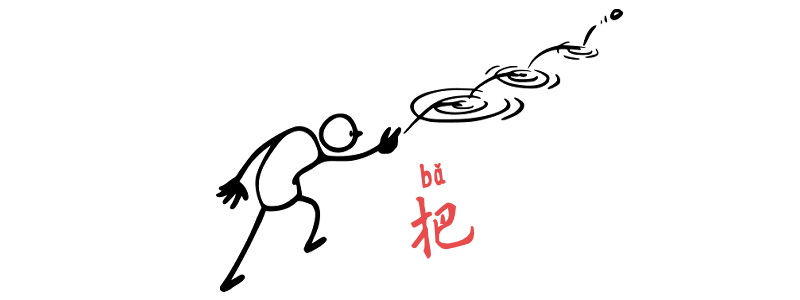
All four structures below still follow the core rule:the object goes right after 把 bǎ把 bǎ, and something has to follow the verb. Here, that “something” gets more varied — repetition, counting, or a simple 了 le了 le.
Before the formal rules — look at these two pictures. Can you guess what’s being said, just from the image?
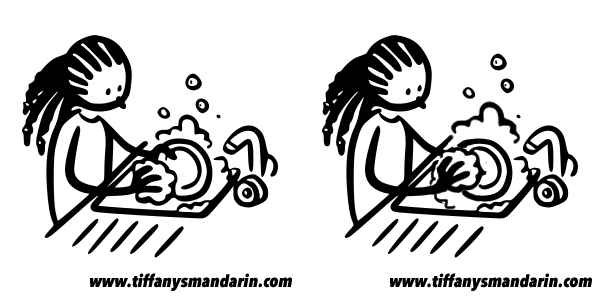
What is he doing with the dishes?
你先去把廚房的碗洗一洗你先去把厨房的碗洗一洗
You go wash the kitchen dishes first. (洗一洗 xǐyìxǐ洗一洗 xǐyìxǐ — a quick, light action.)
👆 Tap to reveal
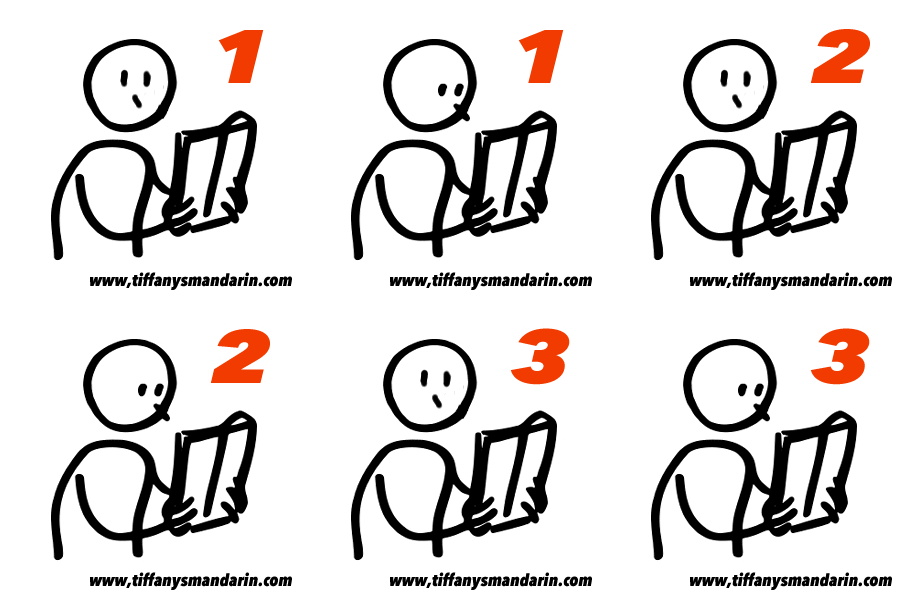
How many times does she want to read the textbook?
我要把這本課本讀3遍我要把这本课本读3遍
I want to read this textbook 3 times.
👆 Tap to reveal
One’s a light, brief action; the other counts exactly how many times. Let’s look at both patterns properly.
1 Structure
(1) Subject + 把 bǎ把 bǎ + Object + Verb (+ 一 yī一 yī / 了 le了 le) + Verb
Repeating the verb (with or without 一 yī一 yī/了 le了 le in between) shows a brief or “just a little” action. This structure can’t be used with negation.
妹妹把玩具收一收妹妹把玩具收一收
My sister tidied up the toys a bit.
等我一下,我把頭髮梳梳就去等我一下,我把头发梳梳就去
Give me a second. I’ll brush my hair and go.
同學們再把試卷檢查一下吧同学们再把试卷检查一下吧
Classmates, please check your papers again.
你把這個句子再唸一唸你把这个句子再念一念
Read this sentence over again.
你幫我把窗簾拉一拉你帮我把窗帘拉一拉
Help me pull the curtains a bit.
(2) Subject + 把 bǎ把 bǎ + Object + Verb + 了 le了 le
A simple completion — the action is done. In spoken Chinese, 給 gěi给 gěi can be inserted before the verb for emphasis (optional but common), and 著 zhe着 zhe can replace 了 le了 le when the meaning is “keep it that way” rather than “finish it.”
他把學過的生詞都給忘了他把学过的生词都给忘了
He forgot all the vocabulary he had learned.
你別忘了把護照帶著你别忘了把护照带着
Don’t forget to take your passport with you.
我把作業寫了我把作业写了
I did my homework.
記得把冷氣開著记得把冷气开着
Remember to leave the AC on.
(3) Subject + 把 bǎ把 bǎ + Object + Verb + Action / Time Measure Complement
An action-measure complement counts how many times something happens (一次 yícì一次 yícì, 十遍 shíbiàn十遍 shíbiàn); a time-measure complement counts how long (三個小時 sāngèxiǎoshí三个小时 sāngèxiǎoshí, 一整天 yìzhěngtiān一整天 yìzhěngtiān).
醫生要我把這個動作做5次医生要我把这个动作做5次
The doctor wants me to do this movement 5 times. (Action measure.)
老師要我把這個字寫10次老师要我把这个字写10次
The teacher asked me to write this character 10 times. (Action measure.)
請你把剛剛的話再說一次请你把刚刚的话再说一次
Please say what you just said again. (Action measure.)
她把這本書看了3天才看完她把这本书看了3天才看完
It took her 3 days to finish reading this book. (Time measure.)
我把這件事想了很久我把这件事想了很久
I thought about this matter for a long time. (Time measure.)
(4) Subject + 把 bǎ把 bǎ + Object + Adverbial Modifier + Verb
Most adverbs go before 把 bǎ把 bǎ. 都 dōu都 dōu is a special exception — it can sit either before 把 bǎ把 bǎ or after the object, and the meaning shifts depending on where it goes.
學生們都把書帶來了学生们都把书带来了
All the students brought their books. (都 dōu都 dōu refers to the subject — every student did this.)
學生們把書都帶來了学生们把书都带来了
The students brought all their books. (都 dōu都 dōu refers to the object — every book was brought.)
他已經把房間打掃乾淨了他已经把房间打扫干净了
He has already cleaned the room. (已經 yǐjīng已经 yǐjīng sits before 把把.)
她悄悄把門關上了她悄悄把门关上了
She quietly closed the door. (悄悄 qiāoqiāo悄悄 qiāoqiāo — the manner adverb — sits before 把把.)
2 Practice
Translate each English sentence into a 把 bǎ把 bǎ sentence, then tap the card to check your answer.
01Let me taste the soup real quick.
讓我把湯嚐一嚐让我把汤尝一尝
Let me taste the soup real quick.
👆 Tap to reveal
02I already finished writing the report.
我已經把報告寫了我已经把报告写了
I already finished writing the report.
👆 Tap to reveal
03I read this novel twice.
我把這本小說看了兩次我把这本小说看了两次
I read this novel twice.
👆 Tap to reveal
04She spent a whole day studying this lesson.
她把這課學了一整天她把这课学了一整天
She spent a whole day studying this lesson.
👆 Tap to reveal
05Everyone finished their exams. (emphasis on “everyone”)
大家都把考試寫完了大家都把考试写完了
Everyone finished their exams.
👆 Tap to reveal
06He finished every single one of the exam questions. (emphasis on “every question”)
他把考題都寫完了他把考题都写完了
He finished every single one of the exam questions.
👆 Tap to reveal
07Try on this shirt for a bit.
把這件衣服試一試把这件衣服试一试
Try on this shirt for a bit.
👆 Tap to reveal
08Don’t forget to leave the window open.
別忘了把窗戶開著别忘了把窗户开着
Don’t forget to leave the window open.
👆 Tap to reveal
09He silently packed his bags.
他默默把行李收拾好了他默默把行李收拾好了
He silently packed his bags.
👆 Tap to reveal
10Please try this dish once.
請把這道菜試一次请把这道菜试一次
Please try this dish once.
👆 Tap to reveal
