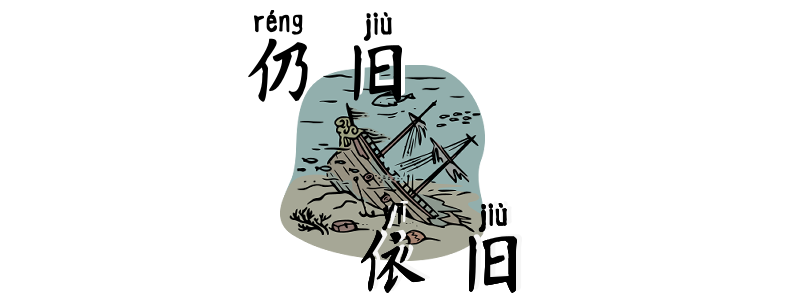
Honestly, there’s no meaningful difference in meaning between 仍舊仍旧 réngjiù and 依舊依旧 yījiù — most of the time you could swap one for the other and no native speaker would blink. The gap is entirely in tone: neutral and steady versus wistful and poetic.
1 Structure
S + 仍舊仍旧 réngjiù + Adj / V
Common in both spoken and written language, though it leans slightly more formal. It often emphasizes something continuing despite expectations or time passing.
十年了,我的中文仍舊不好。十年了,我的中文仍旧不好。
It’s been ten years, and my Chinese is still not good.
他已經道歉很多次了,你仍舊不願意原諒他嗎?他已经道歉很多次了,你仍旧不愿意原谅他吗?
He’s already apologized many times. Do you still refuse to forgive him?
情況仍舊沒有改變。情况仍旧没有改变。
The situation is still unchanged.
我仍舊記得你說過的每一句話。我仍旧记得你说过的每一句话。
I still remember every word you said.
雖然中了彩券變成千萬富翁,她仍舊每天上班。虽然中了彩券变成千万富翁,她仍旧每天上班。
Even though she won the lottery and became a multimillionaire, she still goes to work every day.
S + 依舊依旧 yījiù + Adj / V
More common in written or poetic language. It’s used to evoke a sense of sentimentality or timelessness.
她的笑容依舊燦爛,你的中文也依舊很爛。她的笑容依旧灿烂,你的中文也依旧很烂。
Her smile is still as radiant as ever, and your Chinese is still as bad as ever.
他依舊是那個老樣子。他依旧是那个老样子。
He’s still the same as before.
這次他依舊選擇了沈默。这次他依旧选择了沉默。
This time, he still chose to remain silent.
儘管我離開紐約多年,依舊懷念著那裡的貝果。尽管我离开纽约多年,依旧怀念着那里的贝果。
Even though I left New York years ago, I still miss the bagels there.
時光飛逝,山河依舊。时光飞逝,山河依旧。
Time flies, but the mountains and rivers remain the same.
Fun Fact
時光飛逝,山河依舊时光飞逝,山河依旧 shíguāng fēishì, shānhé yījiù is the kind of line you’d find carved on a pavilion or opening a period drama — 依舊依旧 yījiù shows up constantly in this “nature endures, people change” register that literary Chinese loves.
2 Common Mistakes
Most errors come from stacking on a conflicting 了了 le, or placing 仍舊仍旧 réngjiù / 依舊依旧 yījiù in the wrong spot in the sentence.
❌
情況仍舊沒有改變了。情况仍旧没有改变了。
✅
情況仍舊沒有改變。情况仍旧没有改变。
仍舊仍旧 réngjiù already signals that a state has persisted unchanged, so tacking on 了了 le — which usually marks a new change or development — contradicts that continuity. The sentence ends up reading like the state just changed into “no change,” which cancels itself out.
❌
我記得仍舊你說過的每一句話。我记得仍旧你说过的每一句话。
✅
我仍舊記得你說過的每一句話。我仍旧记得你说过的每一句话。
仍舊仍旧 réngjiù and 依舊依旧 yījiù are adverbs, so they have to sit directly in front of the verb or adjective they modify — right after the subject — never after the verb.
3 仍舊仍旧 vs 依舊依旧
To be honest, there’s no significant difference in meaning, so they can be used interchangeably in most sentences. The choice really depends on personal preference — and the mood you’re going for.
|
仍舊仍旧 réngjiù |
依舊依旧 yījiù |
| Meaning |
Still, as before |
Still, unchanged |
| Tone |
Neutral or persistent |
Nostalgic or poetic |
| Context |
Everyday or formal usage |
Literary, poetic, emotional |
| Example |
情況仍舊沒有改變。情况仍旧没有改变。 |
時光飛逝,山河依舊。时光飞逝,山河依旧。 |
4 How about 仍然 and 依然
- Basically the same — 仍舊仍旧 réngjiù and 仍然仍然 réngrán can be swapped in almost any sentence. 仍舊仍旧 réngjiù just sounds a little more formal.
- Same story with 依舊依旧 yījiù and 依然依然 yīrán — both poetic, both interchangeable, with 依然依然 yīrán being the more common of the two.
5 Practice
Translate each sentence into Chinese, then tap the card to check your answer.
01Even after all these years, he still remembers her birthday.
過了這麼多年,他仍舊記得她的生日。过了这么多年,他仍旧记得她的生日。
👆 Tap to reveal
02No matter how many times I explain, he still doesn’t understand.
不管我解釋了幾次,他仍舊不懂。不管我解释了几次,他仍旧不懂。
👆 Tap to reveal
03The old house still stands quietly at the end of the lane.
老房子依舊靜靜地立在巷子的盡頭。老房子依旧静静地立在巷子的尽头。
👆 Tap to reveal
04Despite the years apart, her love for him remained unchanged.
儘管多年分離,她對他的愛依舊不變。尽管多年分离,她对他的爱依旧不变。
👆 Tap to reveal
05Even after the storm, the flowers in the garden still bloomed.
即使經過了暴風雨,花園裡的花依舊盛開。即使经过了暴风雨,花园里的花依旧盛开。
👆 Tap to reveal
06His attitude is still the same as it was ten years ago.
他的態度仍舊和十年前一樣。他的态度仍旧和十年前一样。
👆 Tap to reveal
07Although the company laid off many people, business still runs normally.
雖然公司裁了很多人,業務仍舊正常運作。虽然公司裁了很多人,业务仍旧正常运作。
👆 Tap to reveal
08The town he grew up in remains, as ever, quiet and unchanged.
他成長的小鎮依舊寧靜如昔。他成长的小镇依旧宁静如昔。
👆 Tap to reveal
09Even after losing everything, he still believed in himself.
即使失去了一切,他仍舊相信自己。即使失去了一切,他仍旧相信自己。
👆 Tap to reveal
10The photo has faded, but the memory in it remains just as vivid.
照片已經褪色,但裡面的回憶依舊鮮明。照片已经褪色,但里面的回忆依旧鲜明。
👆 Tap to reveal
