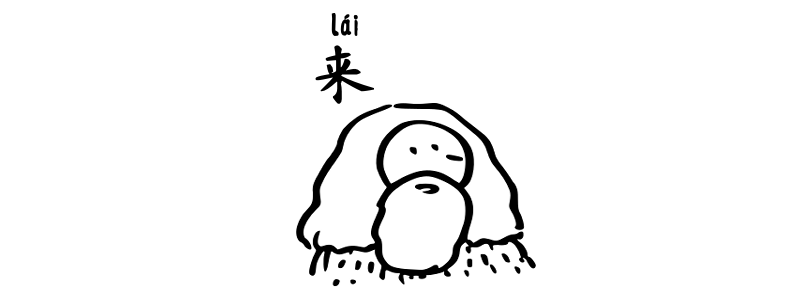
Put 來来 lái after a round number and before the measure word — 二十來来個个 èrshí lái ge, “about twenty.” It’s casual, spoken, and very common in daily conversation.
1Round Number + 來来 lái + Measure Word (+ Noun)
來来 lái goes right after a round number ending in 0 (十 shí, 二十 èrshí, 一百八十 yìbǎi bāshí…) and before the measure word — the same slot as 多 duō. It means “about” or “around” that number, and it sounds casual and spoken.
大約十來個人。大约十来个人。
About ten people.
他身高一百八十來公分。他身高一百八十来厘米。
His height is about 180 centimeters.
我家有五十來本書。我家有五十来本书。
There are about fifty books in my house.
你二十來顆草莓就要賣1000塊錢,也太貴了吧!你二十来颗草莓就要卖1000块钱,也太贵了吧!
Selling twenty-something strawberries for 1000 dollars is too expensive!
算一算,我已經三十來年沒回家了。算一算,我已经三十来年没回家了。
I reckon it’s been about thirty years since I last went home.
年 nián and 歲/岁 suì act as their own measure words
那位奶奶應該有七十來歲。那位奶奶应该有七十来岁。
That grandma should be about seventy years old.
FYI: Senior Life in Taiwan
In Taiwan, seniors aged 65 and above are offered a variety of government-subsidized free courses, including health promotion, leisure activities, arts, humanities, and life education. These courses aim to keep them active and engaged. Organized by local governments or social welfare organizations, these courses provide opportunities for seniors to continue learning and participate in social activities. Additionally, there are transportation subsidies, monthly allowances, and regular health checks to ensure their well-being.
📌 來来 lái Can Also Come Before 萬万 wàn
With big numbers, 來来 lái can sit before 萬万 wàn: 五十來来萬万 wǔshí lái wàn means “about five hundred thousand.” The number in front still ends in 0.
這間房子賣了三十來萬。这套房子卖了三十来万。
This house sold for about three hundred thousand.
2Number 1–9 + Measure Word + 來来 lái + Adjective
With units of weight, length, or distance (公斤 gōngjīn, 公尺/米 gōngchǐ/mǐ, 公里 gōnglǐ…), 來来 lái can also follow a single digit + measure word, usually followed by an adjective like 重 zhòng or 長/长 cháng. Here it means “just about” — a little more or a little less.
這隻狗有五公斤來重。这只狗有五公斤来重。
This dog weighs about five kilograms.
那條魚有一公尺來長。那条鱼有一米来长。
That fish is about one meter long.
3來来 lái vs 多 duō vs 左右 zuǒyòu
All three follow the number, but they don’t mean quite the same thing:
| Example | Meaning |
|---|
| 多 duō | 二十多個个人 èrshí duō ge rén | more than 20 (21–29) |
| 來来 lái | 二十來来個个人 èrshí lái ge rén | about 20 — could be a few more or a few less |
| 左右 zuǒyòu | 二十個个人左右 èrshí ge rén zuǒyòu | about 20 — goes after the measure word / noun |
來来 lái is the most colloquial of the three. 左右 zuǒyòu fits both speech and writing.
4Common Mistakes
❌我有十個來朋友。我有十个来朋友。
✅我有十來個朋友。我有十来个朋友。
With a round number, 來来 lái goes before the measure word, not after it.
❌他喝了三來杯咖啡。他喝了三来杯咖啡。
✅他喝了三杯左右的咖啡。他喝了三杯左右的咖啡。
來来 lái can’t follow a single digit directly. For small, countable things, use 左右 zuǒyòu (or 幾几 jǐ) instead.
5Practice
Try saying each sentence in Chinese, then tap to check.
01They have about thirty cats at home.
他家有三十來隻貓。他家有三十来只猫。
👆 Tap to reveal
02This novel probably has about five hundred thousand words.
這本小說大概有五十來萬字。这本小说大概有五十来万字。
👆 Tap to reveal
03The dishes at this restaurant cost around thirty dollars each.
這個餐廳的菜價差不多三十來塊錢。这个餐厅的菜价差不多三十来块钱。
👆 Tap to reveal
04About forty people came to the party.
來參加派對的有四十來個人。来参加派对的有四十来个人。
👆 Tap to reveal
05His father is about sixty years old.
他爸爸六十來歲。他爸爸六十来岁。
👆 Tap to reveal
06It’s about twenty kilometers from here to the airport.
從這裡到機場有二十來公里。从这里到机场有二十来公里。
👆 Tap to reveal
07This suitcase weighs about eight kilograms.
這個行李箱有八公斤來重。这个行李箱有八公斤来重。
👆 Tap to reveal
08I’ve lived in this city for about ten years.
我在這個城市住了十來年了。我在这个城市住了十来年了。
👆 Tap to reveal
