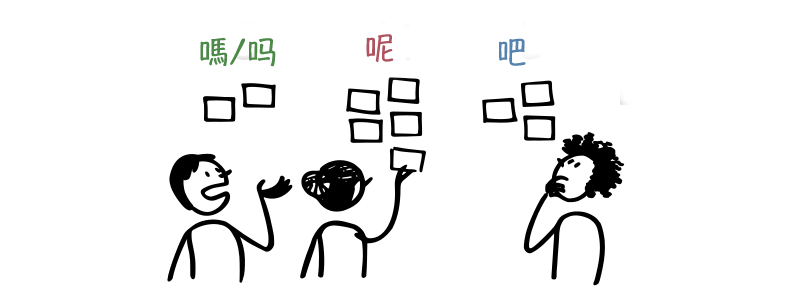
Final particles (語氣詞语气词 yǔqìcí) sit at the very end of a sentence and don’t change its basic meaning — but they completely change its tone. In this first article, we’ll cover the three most common ones: 嗎吗 ma, 吧 ba, and 呢 ne.
Final particles are a nightmare for most learners because they carry attitude, not vocabulary meaning. Listen to each audio clip carefully — the words never change tone, but the whole sentence changes in intonation depending on which particle you use.
1嗎吗 ma
The question you really don’t know the answer to
嗎吗 ma turns a plain statement into a genuine yes-no question. You have no idea what the answer will be.
嗎吗 ma — genuine yes-no question
你是日本人嗎?你是日本人吗?
Are you Japanese?
你喜歡貓嗎?你喜欢猫吗?
Do you like cats?
你忙嗎?你忙吗?
Are you busy?
你不是老師嗎?你不是老师吗?
Aren’t you a teacher? (negation + 嗎吗 ma)
她有狗嗎?她有狗吗?
Does she have a dog?
2 吧 ba
Checking or confirming — you already have a guess
Compare this with 嗎吗 ma: with 吧 ba, you already have some idea what the answer is. You’re just checking.
吧 ba — checking / confirmation
你是日本人吧?你是日本人吧?
You are Japanese, right?
你喜歡貓吧?你喜欢猫吧?
You like cats, don’t you?
Suggestion
吧 ba — suggestion
你學一點中文吧!你学一点儿中文吧!
You should learn some Chinese!
我們今天吃牛肉麵吧!我们今天吃牛肉面吧!
Let’s eat beef noodles today!
Compromise — say it with a slight drawn-out tone
吧 ba — compromise
好吧…好吧…
Fine…. (implying you have no choice but to agree)
那就吃牛肉麵吧…那就吃牛肉面吧…
Fine… then let’s have beef noodles.
3 呢 ne
Bounce-back question — “How about…?”
呢 ne — bounce-back question
我是日本人,你呢?我是日本人,你呢?
I am Japanese, how about you?
你喜歡貓,他呢?你喜欢猫,他呢?
You like cats, how about him?
你今天很忙,明天呢?你今天很忙,明天呢?
You are busy today, how about tomorrow?
Where — Noun + 呢 ne
呢 ne — “where’s…?”
狗呢?狗呢?
Where’s the dog?
我的錢呢?我的钱呢?
Where’s my money?
Softening a question with a question word (a bit casual)
The key difference between 呢 ne and 嗎吗 ma is that 嗎吗 ma is only for yes-no questions, while 呢 ne pairs with question words like 什麼什么 shénme (“what”) or 為什麼为什么 wèishénme (“why”).
呢 ne — softening a wh-question
你要吃什麼呢?你要吃什么呢?
What do you want to eat?
你為什麼喜歡貓呢?你为什么喜欢猫呢?
Why do you like cats?
Persuading someone — often paired with 吧 ba
呢 ne — persuading, paired with 吧 ba
還早呢,再喝一杯吧!还早呢,再喝一杯吧!
It’s still early — let’s have another drink!
中文很簡單呢,你就試試吧!中文很简单呢,你就试试吧!
Chinese is easy — you should give it a try!
Continuation of an action or state (often with 在 zài)
呢 ne — ongoing action
我在吃飯呢!我在吃饭呢!
I am eating right now!
媽媽在生氣呢!妈妈在生气呢!
Mom is angry right now!
Quick Compare
嗎吗 ma = you truly don’t know the answer. 吧 ba = you’re checking a guess, suggesting, or reluctantly agreeing. 呢 ne = bouncing a question back, asking “where,” softening a wh-question, persuading, or marking an ongoing action.
4 Practice
Translate each sentence into Chinese, then tap the card to check your answer.
01Are you Chinese?
你是中國人嗎?你是中国人吗?
👆 Tap to reveal
02You’re not tired, are you?
你不累嗎?你不累吗?
👆 Tap to reveal
03You’re a student, right?
你是學生吧?你是学生吧?
👆 Tap to reveal
04Let’s go home! (suggestion)
我們回家吧!我们回家吧!
👆 Tap to reveal
05Fine, let’s go then. (compromise)
好吧,那就走吧。好吧,那就走吧。
👆 Tap to reveal
06I like coffee, how about you?
我喜歡咖啡,你呢?我喜欢咖啡,你呢?
👆 Tap to reveal
07Where’s my phone?
我的手機呢?我的手机呢?
👆 Tap to reveal
08What do you want to drink?
你要喝什麼呢?你要喝什么呢?
👆 Tap to reveal
09Dad is watching TV right now! (ongoing action)
爸爸在看電視呢!爸爸在看电视呢!
👆 Tap to reveal
10It’s still early, let’s watch a movie! (persuading, 呢 + 吧)