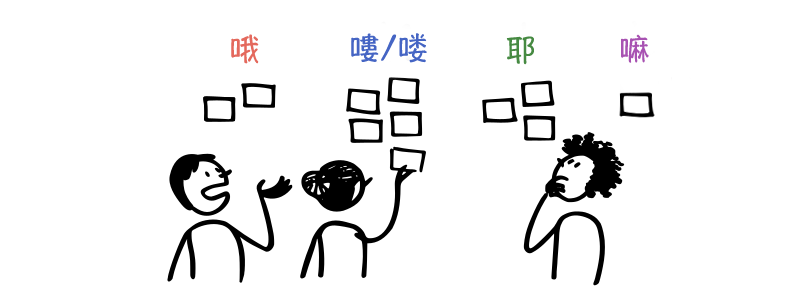
This last set of final particles is the most nuanced: 喔 o softens a wish or warning, 嘍喽 lou is 了 le fused with 喔/哦 o, 耶 ye/欸 ei carries emotional color, and 嘛 ma frames something as obvious or makes a request sound softer.
These four particles rarely show up in textbooks but are everywhere in real conversation. Listen to each clip — the tone shift is subtle, and getting it right is what makes your Chinese sound natural instead of textbook-stiff.
1 喔 o (also written 哦 o)
A wish, warning, or reminder
喔/哦 o — wish, warning, reminder
路上小心哦!路上小心哦!
Stay safe! (warning)
加油喔!加油喔!
Good luck! (wish)
我明天很忙哦!我明天很忙哦!
I’ll be busy tomorrow! (reminder)
Excitement, surprise, or enthusiasm — usually positive (same feel as 啊 a)
喔/哦 o — positive excitement
好哦!好哦!
OK! (excitement)
好可愛哦!好可爱哦!
So cute! (enthusiasm)
2嘍喽 lou (also written 囉啰 luo)
嘍喽 lou is the fusion of new-situation 了 le + 哦 o
嘍喽 lou — 了 le + 哦 o
吃飯嘍!吃饭喽!
Dinner time!!
先睡囉!先睡啰!
I’m going to bed now!
3 耶 ye (also written 欸 ei)
耶 ye reads as more feminine/cute; 欸 ei is more neutral.
Something unexpected
耶/欸 — something unexpected
下雨了耶!下雨了耶!
Oh! It’s raining now!
我好像胖了欸!我好像胖了欸!
Ugh, I think I’ve gained weight!
Annoyance, complaint, or silliness — usually negative (same feel as 啊 a)
耶/欸 — annoyance / complaint
你很煩耶!你很烦耶!
You’re so annoying!
那個超貴欸!!那个超贵欸!!
That’s really expensive!!
Certainty — but softer than 啊 a
耶/欸 — softer certainty
我不知道耶…我不知道耶…
I don’t know…
他家超有錢欸!!他家超有钱欸!!
His family is super rich!!
4 嘛 ma
Something is obvious
嘛 ma — stating the obvious
英文很難嘛~英文很难嘛~
English is hard~ (everyone knows that)
我沒錢嘛~我没钱嘛~
I don’t have money~ (you already know it)
Imploring someone to do something
嘛 ma — imploring
給我一點錢嘛给我一点钱嘛
Give me some money, pleeease~~~~
不要走嘛不要走嘛
Don’t leave, please stay~~
5 For Advanced Learners
Do you know the difference? Every particle in this series can attach to 好 hǎo — and each one gives it a completely different flavor.
好…! — the full family compared
好啊!好啊!
OK! (excited or certain)
好喔!好喔!
OK! (excited)
好嘛!好嘛!
Come on! (begging someone to do something)
好啦!好啦!
Fine! (softly asking someone to do something — not a command)
好哇!好哇!
OK! (same as 好啊!hǎo a)
好耶!好耶!
Yay! (certainty, but softer than 啊 a)
好吧!好吧!
Fine! (compromise)
好嘍!好喽!
Alright! (excitement — it used to sound off, but now it’s completely normal)
好嗎?好吗?
Sounds OK? (a genuine question — you really don’t know the answer)
6 Practice
Translate each sentence into Chinese, then tap the card to check your answer.