Chinese Festivals · 中国节日
China National Day
国庆节 guóqìngjié
The official name is a mouthful: the National Day of the People’s Republic of China, 中华人民共和国国庆节 Zhōnghuá rénmín gònghéguó guóqìngjié. In everyday use, almost everyone just says 国庆节 guóqìngjié.
When is 国庆节 guóqìngjié?
The People’s Republic of China celebrates its anniversary on October 1st. The holiday is officially three days long. In practice, it’s often stretched further with bridge holidays, made up for by working on a nearby weekend.
Some years it extends to a full week. That’s why people also call it the 黄金周 huángjīnzhōu, “Golden Week.”
The world’s biggest week off
黄金周 huángjīnzhōu isn’t just a long weekend. It’s one of two big travel surges each year in China, alongside 过年 guònián. Together they make up the largest annual human migration on Earth, with hundreds of millions traveling domestically in about a week.
One side effect foreign visitors are sometimes surprised by: China’s most famous sites get extremely crowded during Golden Week. Photos of the Great Wall packed shoulder-to-shoulder are practically their own genre of viral post online.
Three things that happen every year
Flag-raising ceremony 🇨🇳 升旗典礼 shēngqí diǎnlǐ
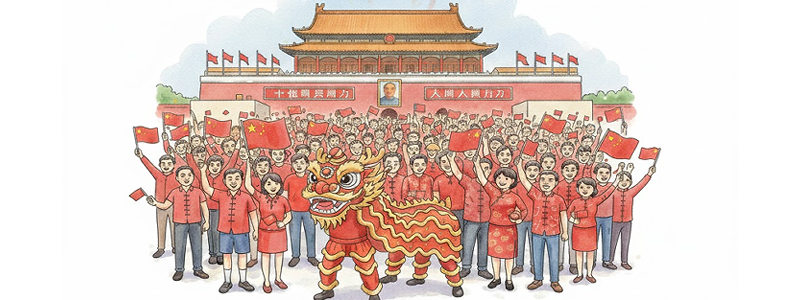
Held every year at Tiananmen Square in Beijing, usually starting around 6 a.m. Crowds gather and sing the national anthem as the flag is slowly raised. Once it reaches the top, doves are released as a symbol of peace.
Giving a speech 🗣️ 致辞 zhìcí
Government officials, including the President or Premier, address the nation. They reflect on the past year’s achievements and lay out goals ahead. President Xi never quite forgets to mention the One China policy and Taiwan along the way. 🥴
Military & civil parade 💂♀️ 阅兵式 yuèbīngshì
Tanks, missiles, and formations of soldiers are on display. Alongside them is a civil parade of floats and performers, representing China’s different regions and ethnic groups.
义勇军进行曲 Yìyǒngjūn jìnxíngqǔ
Known in English as “March of the Volunteers,” it started out as a 1935 film theme song. It became the national anthem of the People’s Republic in 1949, well after its original release.
Fun facts
-
1
The first 国庆节 guóqìngjié was celebrated in 1949, when the People’s Republic of China was founded. That’s much later than Taiwan’s National Day, which marks 1911.
-
2
The first celebrations were held at Tiananmen Square. It’s the same site where the 1989 student-led pro-democracy protests took place, which ended in a violent government crackdown.
-
3
During the Cultural Revolution, 国庆节 guóqìngjié celebrations were banned outright. In their place came a “Day of Mourning” for those who died in the struggle for socialism.
-
4
Celebrations were reinstated in 1971. They’ve been a major annual event ever since, built around displays of national strength and pride.
-
5
In reality, most people don’t attend any of the above. Most prefer to sleep in until noon, or spend the extra days off with family and friends.
双十节 shuāngshíjié — Taiwan’s National Day
Taiwan marks its own National Day on October 10th, just nine days after mainland China’s. The name literally means “Double Ten Day,” from the date itself: the 10th day of the 10th month.
It commemorates the 1911 Wuchang Uprising, which led to the fall of the Qing dynasty. That uprising gave rise to the Republic of China — the government that continues today on Taiwan. Two Chinese-speaking places, two national days, two different founding moments, just over a week apart.

