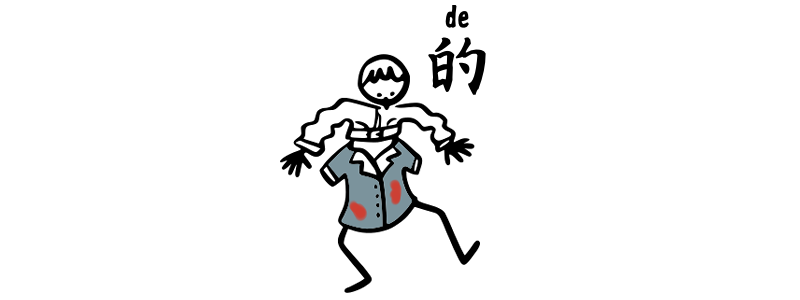
Think of 的的 de as the Chinese equivalent of “‘s” or “of” — it links a noun, pronoun, or adjective to the noun that follows, showing that the first part belongs to or describes the second.
1 Pronoun/Noun + 的的 de + Noun (Possession)
這是我的書这是我的书
This is my book.
那是他的手機那是他的手机
That is his phone.
你的名字是什麼?你的名字是什么?
What is your name?
這是誰的杯子?这是谁的杯子?
Whose cup is this?
2 Adjective + 的的 de + Noun (Description)
這是一件漂亮的衣服这是一件漂亮的衣服
This is a beautiful piece of clothing.
他是一個很好的老師他是一个很好的老师
He is a very good teacher.
我想買紅色的蘋果我想买红色的苹果
I want to buy red apples.
那是一隻可愛的貓那是一只可爱的猫
That is a cute cat.
3 Verb (Phrase) + 的的 de + Noun
A verb or verb phrase can also come before 的的 de to describe a noun — like saying “the food (that) I bought” instead of just “food.”
這是我買的飯这是我买的饭
This is the food (that) I bought.
那是他做的蛋糕那是他做的蛋糕
That is the cake (that) he made.
我喜歡她畫的畫我喜欢她画的画
I like the picture (that) she drew.
這是媽媽煮的湯这是妈妈煮的汤
This is the soup (that) mom cooked.
4 When 的的 de Can Be Dropped
In a few common situations, 的的 de is left out, and the sentence usually sounds more natural without it.
People
For close family members and close friends, 的的 de is usually dropped.
我媽媽很忙我妈妈很忙
My mom is busy.
他是我朋友他是我朋友
He is my friend.
Fixed Groups and Places
For the group or place someone belongs to — like a school, company, or country — 的的 de is usually dropped too.
我們學校很大我们学校很大
Our school is very big.
我家有三個人我家有三个人
There are three people in my family.
Short, One-Syllable Adjectives
A single-syllable adjective usually attaches directly to the noun, without 的的 de.
這是紅蘋果这是红苹果
This is a red apple.
那是一隻小貓那是一只小猫
That is a small cat.
Good to Know
Dropping 的的 de isn’t required — 我的媽媽我的妈妈 and 紅色的蘋果红色的苹果 are both perfectly correct. Dropping it just makes the sentence sound a little closer and more natural, the way “my mom” sounds more natural than “the mom belonging to me.”
5 Common Mistakes
❌
這是誰書?这是谁书?
✅
這是誰的書?这是谁的书?
誰谁 shéi (“who”) plus a noun always needs 的的 de to ask “whose” — it’s never dropped here.
❌
這是漂亮衣服这是漂亮衣服
✅
這是漂亮的衣服这是漂亮的衣服
Two-syllable adjectives like 漂亮漂亮 piàoliang (“pretty”) normally keep 的的 de before the noun — only simple one-syllable adjectives like 紅红 hóng or 小小 xiǎo can skip it.
6 Practice
Translate each sentence into Chinese, then tap the card to check your answer.
01This is my dog. (possessive)
這是我的狗这是我的狗
👆 Tap to reveal
02My dad is a doctor. (people)
我爸爸是醫生我爸爸是医生
👆 Tap to reveal
03Whose bag is this? (possessive)
這是誰的包包?这是谁的包包?
👆 Tap to reveal
04That is a very interesting book. (description)
那是一本很有趣的書那是一本很有趣的书
👆 Tap to reveal
05Our company is very big. (fixed phrase)
我們公司很大我们公司很大
👆 Tap to reveal
06This is the cake (that) I made. (verb phrase)
這是我做的蛋糕这是我做的蛋糕
👆 Tap to reveal
07She is my classmate. (people)
她是我同學她是我同学
👆 Tap to reveal
08This is a small cat. (short adjective)
這是一隻小貓这是一只小猫
👆 Tap to reveal
09This is the picture (that) I drew. (verb phrase)
這是我畫的畫这是我画的画
👆 Tap to reveal
10I want to buy a blue shirt. (description)
我想買藍色的襯衫我想买蓝色的衬衫
👆 Tap to reveal
