Two in Chinese二 èr vs. 两 liǎng
Chinese has two words for “two”: 二 èr and 两 liǎng. They mean the same number, but they’re used in completely different ways.
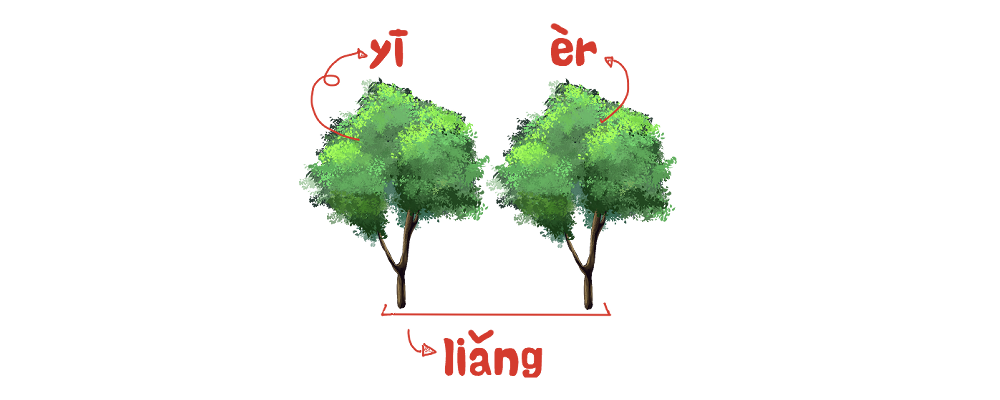
In Chinese, both 二 èr and 两 liǎng mean “two.” However, we use them in completely different ways. 两 liǎng is placed in front of measure words to express a quantity, whereas 二 èr is used when counting numbers.
1Quick Rule
The best way to remember: use 两 liǎng as “quantity two” — and besides that, just use 二 èr.
| Word | Used For | Examples |
|---|---|---|
| 二 èr | Counting and reading numbers, digits inside numbers, ordinals (“second”), dates, minutes, floors | 一二三 yī èr sān, 十二 shí èr, 第二 dì èr, 二月 èr yuè, 二楼 èr lóu |
| 两 liǎng | A quantity of two — in front of a measure word, or in front of big units | 两个人 liǎng ge rén, 两点 liǎng diǎn, 两千 liǎng qiān, 两万 liǎng wàn |
2两 liǎng — Quantity Two
两 liǎng is placed in front of measure words to express a quantity of two. Structure: 两 liǎng + Measure Word + Noun.
3二 èr — Counting and Numbers
二 èr is the numeral itself. Use it when you’re simply counting, naming a number, or when “2” is only one digit inside a longer number.
Don’t use 两 liǎng in 十二岁 shí èr suì. Here “2” is just the last digit of twelve — 十两岁 shí liǎng suì would mean something like “ten-two years,” which isn’t a number at all.
4In Bigger Numbers: Taiwan vs. China
When “2” appears in front of 百 bǎi, 千 qiān, or 万 wàn, usage differs a little between Taiwan and mainland China:
| China | Taiwan | |
|---|---|---|
| 2 | 二 èr | 二 èr |
| 20 | 二十 èrshí | 二十 èrshí |
| 200 | 两百 liǎng bǎi or 二百 èr bǎi | 两百 liǎng bǎi |
| 2,000 | 两千 liǎng qiān or 二千 èr qiān | 两千 liǎng qiān |
| 20,000 | 两万 liǎng wàn | 两万 liǎng wàn |
| 22,222 | 两万二千二百二十二 liǎngwàn èrqiān èrbǎi èrshí èr | 两万两千两百二十二 liǎngwàn liǎngqiān liǎngbǎi èrshí èr |
In Chinese, 万 wàn (10,000) works like a measure word, similar to how “thousand” and “hundred” work in English. That’s why 20,000 is quantity 2 + 万 wàn: 两万 liǎng wàn. The same idea applies to 千 qiān and 百 bǎi.
I’m not sure why mainland China also uses 二百 èr bǎi for 200 — if you know the reason, please share it in the comments!
5Telling the Time
For the hour, you’re counting “two o’clock” as a quantity, so use 两 liǎng. For the minutes, 2 is just a digit, so use 二 èr.
6Use 二 èr to Express “Second”
Ordinal numbers always use 二 èr, never 两 liǎng.
7二月 èr yuè vs. 两个月 liǎng ge yuè
One small word makes a big difference here:
Two can mean “double,” “a pair,” and “again.” It’s an auspicious number in Chinese culture, because people believe good things come in pairs. However, 二 èr has an interesting use in different Chinese dialects, and it’s mostly negative: it’s used as an adjective to ironically describe someone who is arrogant or thoughtless. So when someone calls you 二百五 èr bǎi wǔ (an idiot) or 二愣子 èr lèngzi (a stupid person), it’s not a compliment!
8Common Mistakes
9Practice
Decide whether each sentence needs 二 èr or 两 liǎng, then tap to check.
Enjoyed this post? Buy me a coffee so I can keep writing more of these ☕
Support OneDotDot Chinese