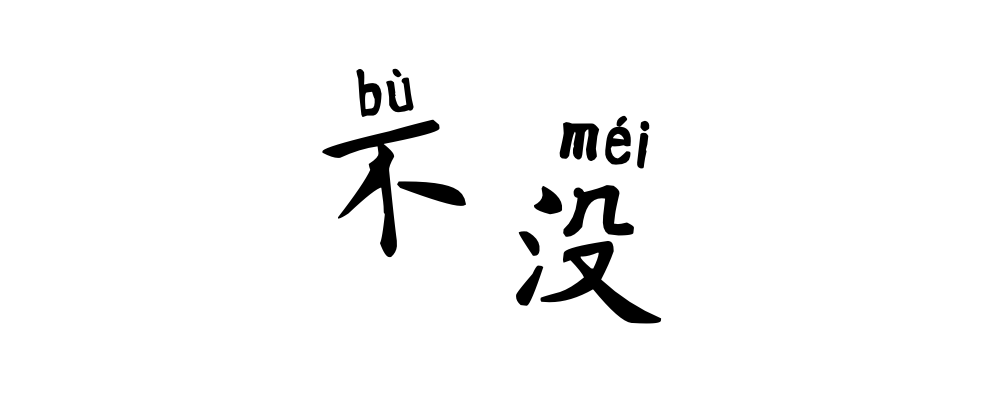
The good news: which one to use almost always comes down to what follows it — a noun, a stative verb (adjective), or a verb. Once you know that, the choice is nearly automatic.
1 At a glance
| Noun | SV (Adj.) | Verb |
|---|
| 不 bù | ✕ | ✓ | ✓ |
| 沒没 méi | ✓ | ✕ | ✓ |
2 With a noun
Always use 沒没 méi
我我沒没工作工作、沒没錢钱、沒没未來未来,只只想想當当米蟲米虫
I have no job, no money, no future. I just want to be a NEET.
💬 米蟲 mǐchóng
Literally “rice bug” — a young person who is neither studying, working, nor training. They just eat and sleep all day, doing nothing, relying on others to take care of them.
他他沒没想法想法
He has no idea.
📌 Optional 有 yǒu
You can insert 有 yǒu between 沒 méi and the noun without changing the meaning.
我我沒有没有時間时间
I don’t have time.
你你沒有没有酒酒嗎吗?
You don’t have alcohol?
3 With a SV (Adj.)
Always use 不 bù
我我不不矮矮、不不胖胖、不不笨笨也也不不醜丑
I am not short, not fat, not stupid, and also not ugly.
那個那个不不貴贵嗎吗?
That is not expensive?
📌 Good to know
Sometimes you may hear 沒 méi + SV in casual speech — that’s because the verb after it has simply been omitted.
你你沒没變变胖胖 → 你你沒没胖胖
You didn’t get fat.
4 With a verb
This is where the real choice lives. 不 bù negates an action someone doesn’t want or doesn’t intend to do — it points forward, toward intention. 沒 méi negates something that didn’t happen, usually in the past — it points backward, toward fact.
我我今天今天不不吃吃晚飯晚饭
I am not going to have dinner tonight. (your decision)
我我今天今天沒没吃吃晚飯晚饭
I didn’t have dinner tonight. (the fact)
你你昨天昨天為什麼为什么不不跟跟我我說話说话
Why didn’t you talk to me yesterday? (I know you did it on purpose)
你你昨天昨天為什麼为什么沒没跟跟我我說話说话
Why didn’t you talk to me yesterday? (just asking — a plain fact, no assumption)
我我不不喝酒喝酒
I don’t drink. (habit / stance)
我我沒没喝酒喝酒 = 我我沒有没有喝酒喝酒
I didn’t drink. (a specific occasion)
📌 Good to know
不 bù vs 沒 méi isn’t really about tense — it’s about intention vs. fact. Ask yourself: “Am I describing a choice/stance, or reporting what did or didn’t happen?” Choice/stance → 不 bù. What happened (or didn’t) → 沒 méi.
⚠️ Common mistake — 是 shì and 有 yǒu
是 shì (“to be”) looks like it should follow the SV pattern, but it’s an exception: it only ever takes 不 bù → 不是 bú shì, never 沒是 méi shì.
有 yǒu (“to have”) is the opposite exception: it only ever takes 沒 méi → 沒有 méiyǒu, never 不有 bùyǒu.
❌我我不不有有錢钱
✅我我沒有没有錢钱
有有 only ever takes 沒没 — never 不不, no matter how tempting the word order feels.
❌我我沒没喜歡喜欢吃吃辣辣
✅我我不不喜歡喜欢吃吃辣辣
喜歡喜欢 describes an ongoing stance, not a one-time completed action — that calls for 不不, not 沒没.
5 還还沒没 háiméi — not yet
還沒 háiméi is 沒 méi’s close companion, used to say something hasn’t happened yet — with the implication that it’s still expected to.
我我還沒还没喝酒喝酒
I haven’t had a drink yet.
她她還沒还没死死
She’s not dead yet. (she’s still alive)
我我還沒有还没有寫作業写作业
I haven’t written my homework yet.
6 Practice
Decide whether each blank needs 不 bù or 沒 méi, then tap the card to check your answer.
01他他____錢钱,所以所以買不起买不起車车。
He has no money, so he can’t afford a car.
沒没 méi — noun (錢钱 qián), always 沒没 méi
👆 Tap to reveal
02這件衣服这件衣服____貴贵,才才三百三百塊块。
This piece of clothing isn’t expensive, only $300.
不 bù — SV (貴贵 guì), always 不 bù
👆 Tap to reveal
03我我昨天昨天____睡覺睡觉,一直一直在在讀書读书。
I didn’t sleep yesterday — I was studying the whole time.
沒没 méi — verb, reporting a past fact
👆 Tap to reveal
04我我明天明天____去去學校学校,因為因为是是假日假日。
I’m not going to school tomorrow, because it’s a holiday.
不 bù — verb, stating a decision about the future
👆 Tap to reveal
05她她____高高,可是可是打籃球打篮球打得很好打得很好。
She’s not tall, but she plays basketball really well.
不 bù — SV (高 gāo), always 不 bù
👆 Tap to reveal
06我我還还____吃吃晚飯晚饭,你你要要一起一起吃吃嗎吗?
I haven’t had dinner yet — want to eat together?
沒没 méi — 還还沒没 háiméi, hasn’t happened yet
👆 Tap to reveal
07他他____想法想法,都都聽听別人别人的的。
He has no ideas of his own — he just goes along with others.
沒没 méi — noun (想法 xiǎngfǎ), always 沒没 méi
👆 Tap to reveal
08你你昨天昨天為什麼为什么____告訴告诉我我這件事这件事?
Why didn’t you tell me about this yesterday? (just asking, plain fact)
沒没 méi — verb, neutral fact, no blame implied
👆 Tap to reveal
09我我____喝咖啡喝咖啡,因為因为晚上晚上會会睡不著睡不着。
I don’t drink coffee, because it keeps me up at night.
不 bù — verb, personal habit/stance
👆 Tap to reveal
10這個問題这个问题____難难,你你一定一定會会。
This question isn’t hard — you’ll definitely get it.
不 bù — SV (難难 nán), always 不 bù
👆 Tap to reveal
