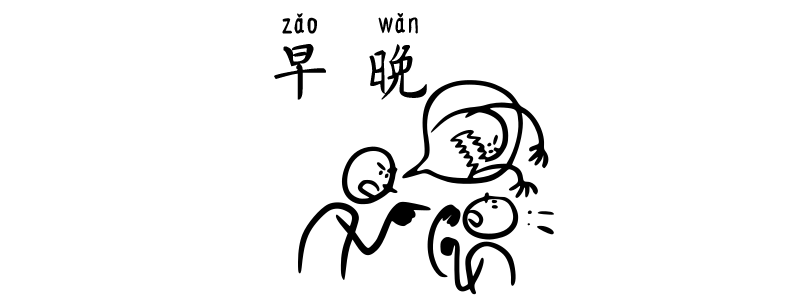
Every day has a morning and an evening — so saying something will happen 早晚早晚 zǎowǎn is really saying “on some morning or some evening, this will come true.” It softens a hard truth into something gentler: not “this will happen,” but “this will happen eventually, so brace yourself.”
1 Structure
早晚早晚 zǎowǎn + Verb Phrase
It can be used to soften the tone when talking about something difficult — bad news, a warning, or even encouragement — usually paired with 會会 huì to point at the future.
這種亂花錢的習慣,早晚會出問題。这种乱花钱的习惯,早晚会出问题。
This kind of reckless spending is bound to cause trouble sooner or later.
早晚你會感謝現在努力的自己。早晚你会感谢现在努力的自己。
Sooner or later, you’ll thank yourself for working hard now.
你這樣不說清楚,早晚會被人誤會。你这样不说清楚,早晚会被人误会。
If you don’t make things clear, you’re bound to be misunderstood.
早晚你會發現他根本沒那麼喜歡你。早晚你会发现他根本没那么喜欢你。
Sooner or later, you’ll realize he’s just not that into you.
車開這麼快,早晚會出事。车开这么快,早晚会出事。
If you keep driving that fast, you’re going to crash sooner or later.
你一直囤東西,家裡早晚會變倉庫。你一直囤东西,家里早晚会变仓库。
If you keep hoarding like this, your house will turn into a warehouse sooner or later.
早晚你會愛上台灣臭豆腐的味道。早晚你会爱上台湾臭豆腐的味道。
Sooner or later, you’ll fall in love with the taste of Taiwan stinky tofu.
Fun Fact
There’s a Mandopop song literally titled 早晚早晚 zǎowǎn — worth a listen if you want to hear the word land naturally in a wistful, love-song context. Watch it on YouTube →
2 Common Mistakes
Most errors come from pairing 早晚早晚 zǎowǎn with the wrong aspect marker, or placing it after the modal verb instead of before it.
❌
他早晚離開了公司。他早晚离开了公司。
✅
他早晚會離開公司。他早晚会离开公司。
早晚早晚 zǎowǎn predicts something that hasn’t happened yet, so it needs a future-pointing word like 會会 huì. Pairing it with 了了 le, which marks a completed action, contradicts the whole point — you can’t predict something that’s already over.
❌
你會早晚感謝現在努力的自己。你会早晚感谢现在努力的自己。
✅
你早晚會感謝現在努力的自己。你早晚会感谢现在努力的自己。
早晚早晚 zǎowǎn has to come before the modal verb 會会 huì, not after it — either right before the subject or right after it, but always ahead of 會会 huì itself.
3 早晚早晚 vs 遲早迟早
遲早迟早 chízǎo (“late and early”) is the other common way to say “sooner or later,” and it’s close enough to 早晚早晚 zǎowǎn that they’re often interchangeable — the difference is mostly in flavor.
|
早晚早晚 zǎowǎn |
遲早迟早 chízǎo |
| Literal image |
“Morning and evening” — a homey, everyday picture |
“Late and early” — a more abstract, neutral pairing |
| Tone |
Warmer, more conversational — fits advice, teasing, encouragement |
Slightly more serious or formal — fits warnings, proverbs, written Chinese |
| Context |
Everyday speech, texting, casual predictions |
News, essays, business or legal warnings, set expressions |
| Example |
車開這麼快,早晚會出事。车开这么快,早晚会出事。 |
這種問題遲早會爆發。这种问题迟早会爆发。 |
4 Practice
Translate each sentence into Chinese, then tap the card to check your answer.
01If you keep staying up late, your health will suffer sooner or later.
你一直熬夜,早晚會影響健康。你一直熬夜,早晚会影响健康。
👆 Tap to reveal
02Sooner or later, everyone will understand your choice.
早晚大家都會理解你的選擇。早晚大家都会理解你的选择。
👆 Tap to reveal
03If you don’t save any money, you’re bound to run into trouble sooner or later.
你都不存錢,早晚會出問題。你都不存钱,早晚会出问题。
👆 Tap to reveal
04Sooner or later, the truth will come out.
真相早晚會大白。真相早晚会大白。
👆 Tap to reveal
05If you keep eating like this, you’ll gain weight sooner or later.
你這樣吃下去,早晚會變胖。你这样吃下去,早晚会变胖。
👆 Tap to reveal
06Sooner or later, you’ll get used to living here.
早晚你會習慣住在這裡。早晚你会习惯住在这里。
👆 Tap to reveal
07If he keeps lying like this, he’ll get caught sooner or later.
他一直這樣說謊,早晚會被拆穿。他一直这样说谎,早晚会被拆穿。
👆 Tap to reveal
08Sooner or later, this company will go public.
這家公司早晚會上市。这家公司早晚会上市。
👆 Tap to reveal
09If you keep ignoring the problem, it’ll blow up sooner or later.
你一直不理這個問題,早晚會爆發。你一直不理这个问题,早晚会爆发。
👆 Tap to reveal
10Sooner or later, you’ll find someone who truly appreciates you.
早晚你會遇到真正懂你的人。早晚你会遇到真正懂你的人。
👆 Tap to reveal
