Chinese Festivals · 中国节日
Moon Festival
中秋节 zhōngqiūjié
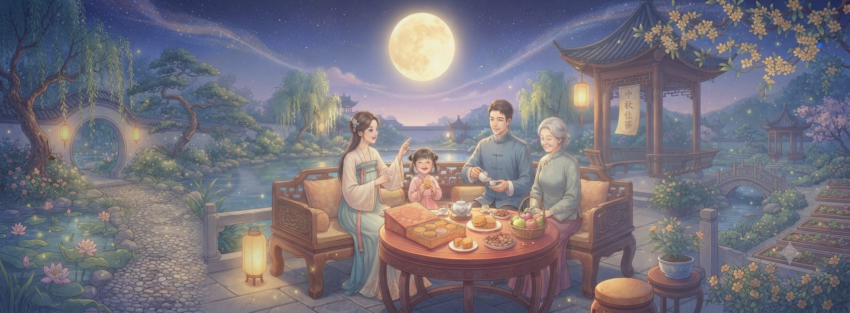
中秋节 zhōngqiūjié falls on the 15th day of the eighth lunar month, when the moon turns into a perfect circle. It’s a night of worshipping the moon and giving thanks for the harvest. Families gather, much like Taiwan and China’s answer to Thanksgiving.
What is 中秋节?
In English you’ll see a few different names for it. Common ones include the Moon Festival, the Mid-Autumn Festival, and the Mooncake Festival — all the same holiday. It’s one of the three most important festivals on the Chinese calendar, alongside 过年 guònián and 端午节 duānwǔjié.
Traditionally, it’s a holiday for worshipping the moon. On this night, the moon becomes a perfect circle — 圆 yuán. That roundness stands for two things at once. One is 圆满 yuánmǎn, satisfaction and perfection for the harvest. The other is 团圆 tuányuán, family reunion. It’s celebrated much the way Thanksgiving is celebrated in the US.
Five things people do
Enjoy mooncakes 🥮 月饼 yuèbǐng
Bought as gifts to show gratitude — to family, friends, even business partners. Younger generations often skip the traditional oily, heavy version. Ice cream mooncakes, fruit mooncakes, and mooncake-shaped biscuits have become popular alternatives instead.
Admire the full moon 🌕 赏月 shǎngyuè
Families go outside together to look at the moon, sometimes with an outdoor gathering. Parents tell moon stories to their kids while they watch. One rule to keep in mind: don’t point at the moon. It’s said to anger the Moon Goddess — and you might wake up with a small cut on your ear.
BBQ (Taiwan only) 🍖 烤肉 kǎoròu
A newer, distinctly Taiwanese tradition. Grill kits appear on sidewalks and outside apartment buildings island-wide, with neighbors barbecuing together. It’s arguably a livelier alternative to just standing around admiring the moon.
Reunion 团圆 tuányuán
中秋节 usually comes with a 3-day break, giving people working far from home time to travel back. Those who can’t make it call home instead. That way, the whole family can look at the same moon together, “under the same sky.”
Money 🧧 红包 hóngbāo
On the first day back at the office, many employees receive a small bonus. It’s a way for the company to say thanks for their work. It’s also common now for young people to send their parents a “red envelope” — often just digitally, over WeChat.
月饼 & 柚子
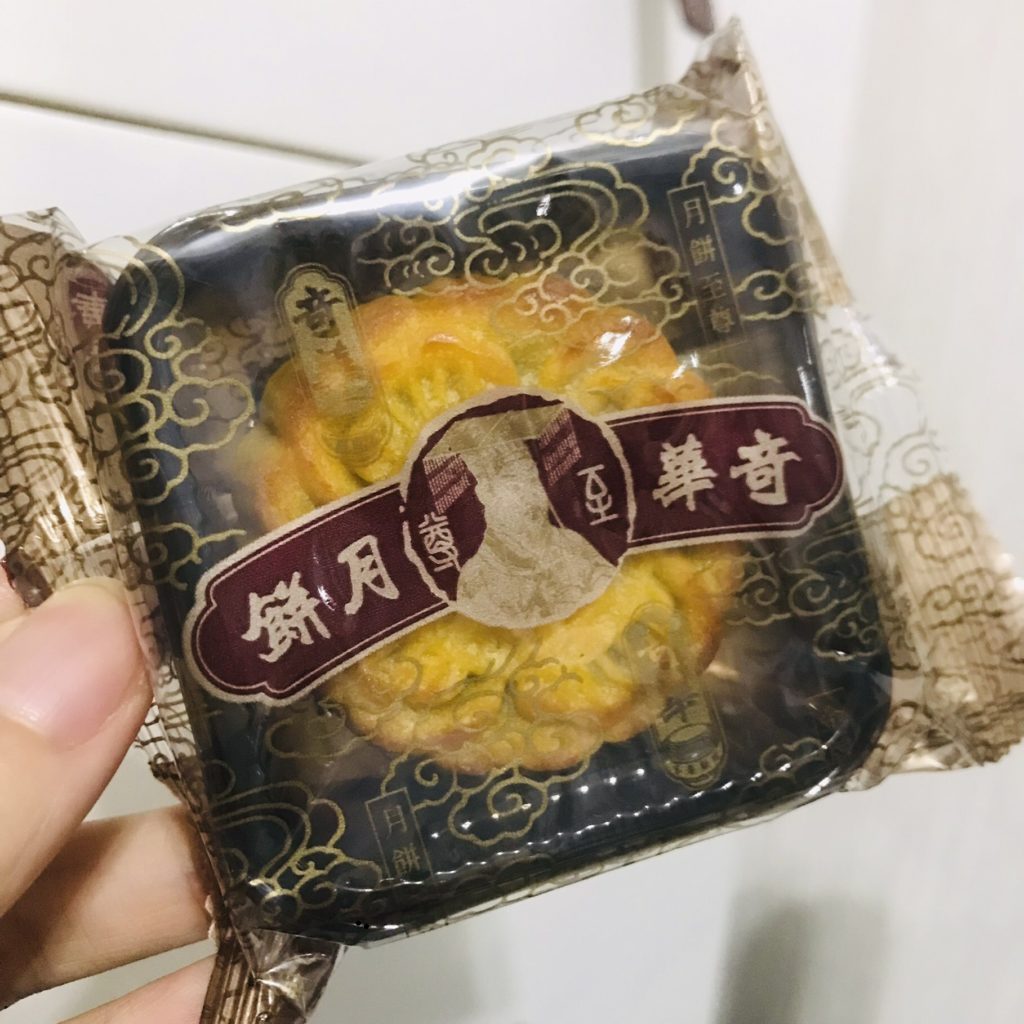
A salted egg yolk is baked into the center, giving off a soft “lunar” glow. The yolk stands in for the moon itself. Around it sits a dense paste filling: mung bean, red bean, jujube, or lotus seed are all common. Sweet with a touch of salty, and quite high in calories — best paired with a strong tea.
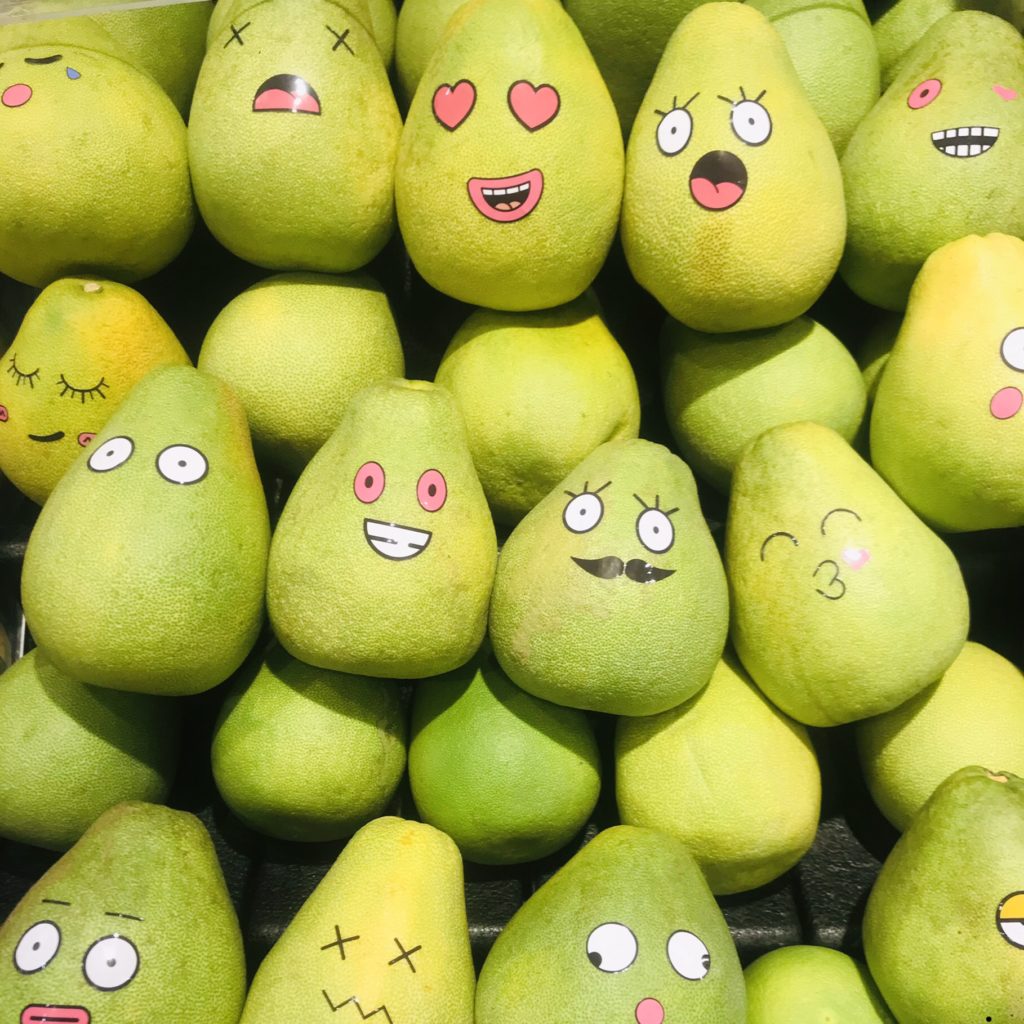
Pomelo — eaten simply because it’s in season. Low in calories and rich in fiber, it helps digest all that heavy mooncake. In Taiwan, people don’t “peel” (剥 bō) a pomelo — they “kill” it (杀 shā). Afterward, kids wear the hollowed-out rind on their heads like a hat. It’s not for laughs — it’s believed to help keep mosquitoes away while everyone’s outside.
A rebellion, baked in. One popular legend claims mooncakes helped overthrow the Mongol-led Yuan dynasty. Han rebels supposedly hid coordinated uprising messages inside the pastries. Mongol rulers didn’t eat mooncakes, so they had no reason to inspect them closely. The message spread in plain sight.
Is the moon actually fuller that night?
Not physically, no. The moon doesn’t get any “more full” on this date than during any other month’s full moon. What makes it special is timing. 中秋节 lands on the full moon closest to the autumn equinox. That moon tends to rise earlier and sit lower and brighter in the sky than usual. In English, Western astronomy calls that same moon the “Harvest Moon” — for almost exactly the same seasonal reason.
When luxury brands make mooncakes
Mooncake gifting has become its own small industry — and in recent years, fashion houses have joined in. Gucci, Louis Vuitton, and Saint Laurent have all released their own logo-branded mooncake boxes as limited-edition seasonal gifts. They’re treated less like pastry and more like a collectible. It’s the same gifting instinct behind 月饼 as ever — just with a much higher price tag.
Stories related to 中秋节
The best-known moon legend, about a beautiful woman who ends up living on the moon. There are several different versions of exactly how and why — some kinder to her than others.
About a rabbit who becomes a medicine god. It’s this shape — not a “man in the moon” — that many East Asian cultures traditionally see in the moon’s surface.
About a lazy man who always gives up easily. He’s sent to the moon to chop down a self-healing tree, and ends up stuck chopping forever.
The same moon, several festivals
Arguably an even bigger holiday than 中秋节 is in China. It’s a multi-day holiday built around ancestral rites and family travel — closer in scale to Korea’s version of Thanksgiving.
A quieter, more aesthetic occasion: moon viewing parties with rice dumplings (dango) and pampas grass on display. Closer to a seasonal art appreciation ritual than a big family gathering.
Leans much more toward children, with colorful paper lanterns, lion dances, and star-shaped lanterns carried through the streets. It feels closer to a Vietnamese “Children’s Day” than an adult reunion holiday.

