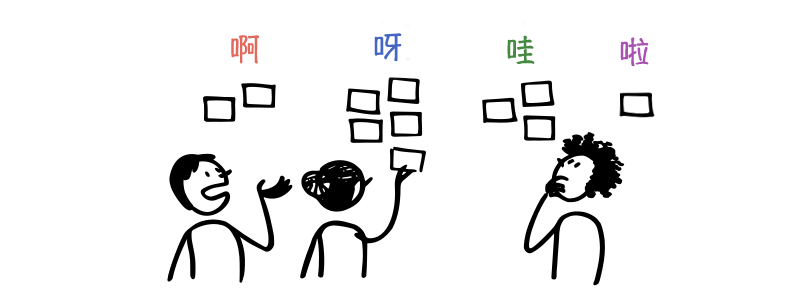
These five final particles are really just one particle — 啊 a — in disguise. 呀 ya, 哇 wa, and 哪 na are sound-changed versions that appear automatically depending on the sound right before them, while 啦 la is 了 le fused with 啊 a.
Final particles are a nightmare for most learners because they carry attitude, not vocabulary meaning. Listen carefully to each clip below — the linking sounds (呀/哇/哪) exist purely so 啊 a flows naturally after certain vowels and consonants.
啊 a family — general intonation preview
1 啊 a
Exclamation — excitement, surprise, or enthusiasm
啊 a — exclamation
你是日本人啊!你是日本人啊!
You are Japanese! (I’m surprised you’re Japanese.)
你也喜歡貓啊!你也喜欢猫啊!
You like cats too! (I’m excited we both like cats!)
Certainty, obviousness, or urgency
啊 a — certainty / urgency
我很忙,所以不能去啊我很忙,所以不能去啊
I was busy, so I couldn’t go. (obviousness)
快說啊!快说啊!
Tell me now! (urgency)
Questions with impatience, annoyance, or concern
啊 a — impatient question
你去不去啊?你去不去啊?
Are you going or not? (annoyance)
你想說什麼啊?你想说什么啊?
What do you want to say? (impatient)
2 啦 la
啦 la is the fusion of new-situation 了 le + 啊 a
啦 la — 了 le + 啊 a
你不愛他啦!你不爱他啦!
You don’t love him anymore!?
你要走啦?你要走啦?
Are you leaving now?
3 呀 ya, 哇 wa, and 哪 na
These last three particles share the same meaning as 啊 a — they’re just linking sounds between 啊 a and whatever sound comes right before it.
Sound before 啊 a
+ 啊 a
= Linking sound
Example
-i, -ü, -a, -e, -o
+ 啊 a
= 呀 ya
duì + a = duì ya
-u, -ao
+ 啊 a
= 哇 wa
hǎo + a = hǎo wa
-n
+ 啊 a
= 哪 na
tiān + a = tiān na
everything else
+ 啊 a
= 啊 a
zǒu + a = zǒu a
Good to Know
The syllables zhi, chi, shi, ri, zi, ci, si, ji, qi, and xi don’t actually carry a true “i” vowel sound, so they don’t change the pronunciation of 啊 a — “shì a” and “jī a” simply keep the plain 啊 a sound. And no matter which written form you choose — 啊 a itself, or 呀 ya / 哇 wa / 哪 na — you always pronounce the linking sound out loud.
呀 ya — after -a, -o, -e, -i, -ü
呀 ya
對呀!对呀!
Right!
來呀!来呀!
Come on!
哇 wa — after -ao, -u
哇 wa
好哇!好哇!
OK!
早哇!早哇!
Morning!
哪 na — after -n (rarely written this way)
哪 na
你好煩啊!你好烦啊!
You are so annoying! (pronounced “na” even though written 啊)
我的天啊!我的天啊!
Oh my gosh!
4 Practice
Translate each sentence into Chinese, then tap the card to check your answer.
01You’re here! (excited exclamation)
你來了啊!你来了啊!
👆 Tap to reveal
02Hurry up! (urgency)
快點啊!快点啊!
👆 Tap to reveal
03What are you doing? (impatient)
你在做什麼啊?你在做什么啊?
👆 Tap to reveal
04He isn’t coming anymore! (new situation)
他不來啦!他不来啦!
👆 Tap to reveal
05Are you eating already?
你要吃飯啦?你要吃饭啦?
👆 Tap to reveal
06Right! (after -ui)
對呀!对呀!
👆 Tap to reveal
07Come here! (after -i)
你過來呀!你过来呀!
👆 Tap to reveal
08That’s really great! (after -ao)
真好哇!真好哇!
👆 Tap to reveal
09Oh my gosh! (after -n)
天啊!天啊!
👆 Tap to reveal
10You are so annoying! (after -n)
你好煩啊!你好烦啊!
👆 Tap to reveal
5 For Advanced Learners
啊 a — To list items
啊 a — listing items
我的冰箱有蘋果啊、蛋啊、牛肉啊,很多東西!我的冰箱有苹果啊,蛋啊,牛肉啊,很多东西!
There’re so many things in my fridge, such as apples, eggs, beef, etc.
啦 la — These usages only in Taiwan
To request someone to do something, in a soft tone as if begging, not commanding
啦 la — soft request
好啦~一起去啦~好啦~一起去啦~
Go with me, please~~
明天再打掃啦~我今天好累!明天再打扫啦~我今天好累!
Can we do the cleaning tomorrow? I’m so tired today, please~