公然 gōngrán — “Openly, Brazenly”
公然 gōngrán describes doing something in plain sight, without any attempt to hide it — and almost always something wrong, shameless, or against the rules. It’s a formal, written-register adverb common in news reports and legal language.
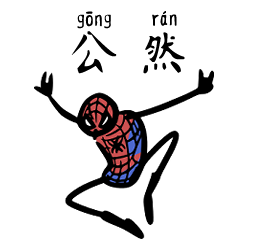
The key feature of 公然 gōngrán is the shamelessness — someone does something they clearly shouldn’t, and does it right out in the open instead of hiding it. That’s what separates it from a neutral word like 公开 gōngkāi (“publicly”), which carries no judgment at all.
1 Structure
S + 公然 gōngrán + VP
Sits right before the verb phrase. It pairs naturally with verbs describing wrongdoing — lying, violating rules, insulting someone, provoking, stealing — anything done without any attempt at concealment or shame.
Did you know that name-calling in Taiwan can technically count as 公然侮辱 gōngrán wǔrǔ (“public insult”) — a real criminal offense? A Taiwanese legal site actually crunched over 170 court rulings to see what different insults cost in practice. The numbers below come from that breakdown.
| Insult | Rough meaning | Conviction rate | Avg. fine |
|---|---|---|---|
| 疯子 fēngzi | “lunatic” | 88% | NT$4,905 |
| 三字经 sānzìjīng | a common 3-character swear | 85% | NT$2,636 |
| 废物 fèiwù | “useless piece of junk” | 75% | NT$4,267 |
| 王八蛋 wángbādàn | “bastard” | 73% | NT$4,000 |
| 垃圾 lājī | “garbage” | 67% | NT$2,750 |
| 智障 zhìzhàng | a slur for “mentally disabled” | 67% | NT$3,786 |
| 杂种 zázhǒng | “bastard, mongrel” | 63% | NT$4,583 |
| 贱人 jiànrén | “bitch” | 60% | NT$2,000 |
| 白痴 báichī | “idiot” | 43% | NT$4,222 |
A few things worth knowing: courts generally only fine a few thousand NT dollars — the maximum penalty under the law is around NT$9,000 (higher if the insult is physical, like throwing water or an egg at someone). Flipping someone off counts too, without a word needing to be said — typically NT$1,000-4,000, though it jumps sharply if the person on the receiving end is a police officer. And context matters since a 2024 constitutional court ruling: shouting an insult once in a heated moment and being deliberately, repeatedly abusive toward one specific person can land very differently in front of a judge, even for the same word. (Source: SimpleLaw, 2026 — for general knowledge only, not legal advice.)
2 Common Mistakes
The trap is reaching for 公然 gōngrán for any public action — but it only fits when the action is shameless or wrong.
3 公然 vs 公开
A quick side-by-side of the two words.
| 公然 gōngrán | 公开 gōngkāi | |
|---|---|---|
| Connotation | Negative — shameless, brazen, wrong | Neutral — no judgment implied |
| Typical use | Lying, violating rules, insulting, stealing, provoking | Announcing, apologizing, publishing, voting |
| English feel | “Openly” in the sense of “brazenly, without shame” | “Publicly, in the open” — purely factual |
4 Practice
Translate each sentence into Chinese, then tap the card to check your answer.
Enjoyed this post? Buy me a coffee so I can keep writing more of these ☕
Support OneDotDot Chinese