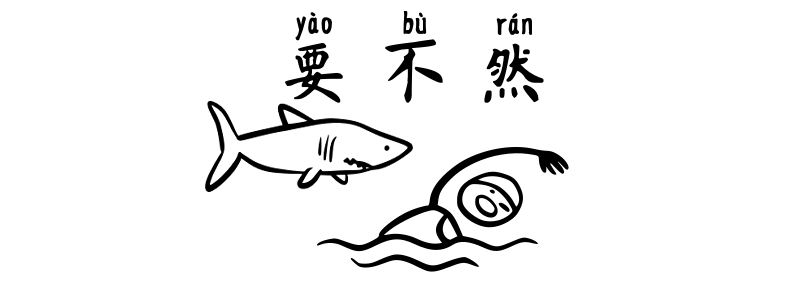
要不然 yàoburán has three main jobs: warning of a consequence (“otherwise”), pairing with 除非 chúfēi to mean “unless,” and proposing an alternative (“how about instead”).
1 Structure
Condition + 要不然 yàoburán + Result
First, state a situation or fact, then add 要不然 yàoburán followed by the result or consequence if this situation or fact doesn’t hold true. It’s often translated as “otherwise” in English.
我要走了,要不然會趕不上火車我要走了,要不然会赶不上火车
I’m about to leave; otherwise, I’ll miss the train.
快點睡覺,要不然明天起不來快点睡觉,要不然明天起不来
Go to bed early; otherwise, you won’t be able to wake up tomorrow.
不要吃太辣,要不然等一下你就肚子痛不要吃太辣,要不然等一下你就肚子疼
Don’t eat too spicy; otherwise, your stomach will ache later.
Note: Taiwan tends to say 肚子痛 dùzi tòng, while the mainland more often says 肚子疼 dùzi téng — both simply mean “stomach ache.”
你少喝點咖啡,不然晚上會睡不著你少喝点咖啡,不然晚上会睡不着
Drink less coffee; otherwise, you won’t be able to sleep at night.
Here 不然 bùrán is used on its own — a common, more casual shortening of 要不然 yàoburán.
Note
The first clause should be a statement, not a question — 要不然 yàoburán attaches to a fact or situation, not to a question. (See Common Mistakes below for the pattern to use with questions.)
除非 chúfēi + Condition + 要不然 yàoburán + Result
除非 chúfēi translates to “unless” or “except if” in English. It introduces a condition that must be met for the subsequent result to happen. It’s a frequently used pairing with 要不然 yàoburán.
除非你也去中國旅行,要不然我不去除非你也去中国旅行,要不然我不去
I won’t go unless you also travel to China.
除非這個工作有很多錢,啊不然我不做除非这个工作有很多钱,啊不然我不做
I won’t take the job unless it pays well.
除非他說他愛我,要不然我不可能跟他結婚除非他说他爱我,要不然我不可能跟他结婚
I won’t marry him unless he says he loves me.
除非你生病,要不然都要12小時前請假除非你生病,要不然都要12小时前请假
Unless you’re sick, you need to request leave 12 hours in advance.
Statement with Option 1 + 要不然 yàoburán + Option 2
Used to propose an alternative choice, often translating to “how about” in English.
FYI · Casual variants
Native speakers rarely say the full 要不然 yàoburán in casual speech. You’ll hear it shortened to plain 不然不然 bùrán everywhere, or dressed up with a leading syllable as 那不然那不然 nà bùrán (“well then, how about…”) or 啊不然啊不然 a bùrán (a more offhand, conversational “or how about…”). All of them work the same way grammatically.
你不喜歡吃火鍋,要不然我們去吃壽司你不喜欢吃火锅,要不然我们去吃寿司
You don’t like hot pot, so how about we go for sushi?
你星期三沒空,那不然我們星期五上課你星期三没空,那不然我们星期五上课
You’re not available on Wednesday, so how about we have class on Friday instead?
他最近很忙,要不然這次吃飯就別找他了他最近很忙,要不然这次吃饭就别找他了
He’s been really busy lately, so let’s not bother inviting him this time.
A:我手痛不能打籃球我手痛不能打篮球
My hand hurts, so I can’t play basketball.
B:啊不然我們踢足球?啊不然我们踢足球?
How about we play soccer instead?
A:明天會下雨,我們別去野餐了明天会下雨,我们别去野餐了
It’s going to rain tomorrow, let’s not go for a picnic.
B:不然我們改看電影?不然我们改看电影?
How about we watch a movie instead?
2 Common Mistakes
In English, it’s common to structure a sentence as a question followed by “otherwise” — e.g. “Do you have time tomorrow? Otherwise, I’ll go to the library.” Attaching 要不然 yàoburán directly onto a question like this feels abrupt in Chinese.
❌
你星期三有空嗎?要不然我打算去圖書館你星期三有空吗?要不然我打算去图书馆
✅
你星期三有空嗎?不然的話我打算去圖書館你星期三有空吗?不然的话我打算去图书馆
After a question, 要不然 yàoburán (or plain 不然 bùrán) on its own sounds abrupt. Pair it with 的話 dehuà instead — 不然的話 bùrán dehuà is the natural match for the English “Question …? Otherwise, …” pattern.
Question + 不然的話 bùrán dehuà + Result
你要吃嗎?不然的話我就吃掉了你要吃吗?不然的话我就吃掉了
Do you want to eat? Otherwise, I’ll eat it.
你確定會去參加派對嗎?不然的話我就跟別人一起去了你确定会去参加派对吗?不然的话我就跟别人一起去了
Are you sure you’ll attend the party? Otherwise, I’ll go with someone else.
3 Practice
Translate each sentence into Chinese, then tap the card to check your answer.
01Hurry up and leave, otherwise you’ll be late.
你快點出門,要不然會遲到你快点出门,要不然会迟到
👆 Tap to reveal
02I won’t pay attention to you unless you apologize to me first.
除非你先跟我道歉,要不然我不會理你除非你先跟我道歉,要不然我不会理你
👆 Tap to reveal
03You don’t feel like cooking today, so how about we order delivery?
你今天不想煮飯,要不然我們叫外送?你今天不想煮饭,要不然我们叫外送?
👆 Tap to reveal
04Remember to bring an umbrella, otherwise you’ll get soaked later and that’ll be a hassle.
記得帶傘,不然等一下淋濕了很麻煩记得带伞,不然等一下淋湿了很麻烦
👆 Tap to reveal
05Unless the company gives me a raise, I plan to change jobs.
除非公司加薪,要不然我打算換工作除非公司加薪,要不然我打算换工作
👆 Tap to reveal
06Your phone’s dead, how about using my charger for now?
你手機沒電了,要不然先用我的充電器?你手机没电了,要不然先用我的充电器?
👆 Tap to reveal
07Drink more water, otherwise your cold won’t get better easily.
多喝點水,要不然感冒不容易好多喝点水,要不然感冒不容易好
👆 Tap to reveal
08Unless the boss personally agrees, this can’t be changed.
除非老闆親自同意,要不然這件事不能改除非老板亲自同意,要不然这件事不能改
👆 Tap to reveal
09You don’t like this restaurant, so how about we switch to another one?
你不喜歡這間餐廳,要不然我們換一家?你不喜欢这间餐厅,要不然我们换一家?
👆 Tap to reveal
10A: I’m not feeling great today, I might not be able to go to class. B: Then how about you rest at home first — I’ll request leave for you.
A:我今天有點不舒服,可能沒辦法去上課。B:那不然你先在家休息,我幫你請假A:我今天有点不舒服,可能没办法去上课。B:那不然你先在家休息,我帮你请假
👆 Tap to reveal
