Chinese Festivals · 中国节日
Qixi Festival
七夕 qīxī
七夕 qīxī falls on the seventh day of the seventh lunar month. It’s the one night a year when two star-crossed lovers are said to cross the Milky Way and reunite.
What is 七夕?
You’ll see it called a few different things in English. Common names include the Qixi Festival, the Double Seventh Festival (a literal translation of the date), the Magpie Festival, and — most often today — Chinese Valentine’s Day. All of them trace back to the same legend. Two lovers are separated by a river of stars, and allowed to meet just once a year.
牛郎织女 Niúláng Zhīnǚ
织女 Zhīnǚ, the Weaver Girl, was a fairy who wove the clouds for the Queen Mother of Heaven. Then she fell in love with 牛郎 Niúláng, a mortal cowherd, and secretly came down to marry him.
So — how did they actually meet? Here’s where the story gets a little uncomfortable by modern standards. In the older, traditional telling, Zhīnǚ came down to bathe in a lake. Niúláng spotted her and stole her fairy robe so she couldn’t fly home. Then he told her she had to marry him. With no way home, she reluctantly agreed, and only grew to love him over time. Told plainly, that’s a kidnapping.
Most versions told today have quietly rewritten this part. Instead, an ox snags Zhīnǚ’s robe by accident, and Niúláng simply helps her get it back. It’s a meet-cute instead of a coercion — and how the two end up together in the version most people learn now.
They lived happily for years and had two children. Then the Queen Mother discovered the truth and dragged Zhīnǚ back to the heavens.
Niúláng chased after her, wearing his ox-hide cloak, his two children carried in baskets over his shoulders. Just as he was about to catch up, the Queen Mother scratched a line across the sky with her hairpin. It tore open into a vast, uncrossable river — the Milky Way, known in Chinese as 天河 tiānhé, the “Silver River.”
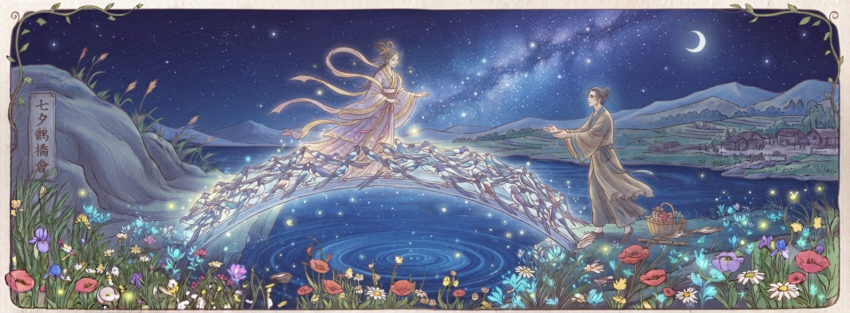
Moved by their devotion, the Queen Mother allowed them one exception. Once a year, on the seventh day of the seventh month, a flock of magpies flies up to form a bridge — 鹊桥 quèqiáo, the “Magpie Bridge.” It lets the two cross the river and spend one night together.
Some tellings add a bittersweet detail. If it rains on 七夕, it’s said to be the lovers’ tears of joy at reunion. Darker versions say it’s the blood of the magpies, worn bare from carrying two people across the sky.
乞巧 qǐqiǎo — begging for skill
Long before it was a couples’ holiday, 七夕 belonged to young women. Since Zhīnǚ was a master weaver, girls prayed to her for skill in needlework and household crafts. The whole festival was once built around this idea.
穿针乞巧 chuān zhēn qǐqiǎo
A needle-threading contest, done by moonlight or candlelight. Whoever threaded fastest was believed to have received the most skill from Zhīnǚ herself.
拜织女 bài Zhīnǚ
Families set out fruit, flowers, and incense under the open sky. Then they kneel to pray to the Weaver Girl for cleverness, good needlework, and — eventually — a good marriage.
晒书晒衣 shài shū shài yī
An unrelated but conveniently timed custom: airing out books and clothing in the summer sun. It kept mold and moths away, since the season made storage damp.
七娘妈 Qī Niángmā
In Taiwan, 七夕 belongs to 七娘妈 Qī Niángmā, a guardian goddess of children. She’s believed to be either Zhīnǚ herself, or one of seven star sisters. They watch over kids until the children come of age.
One of the more surprising offerings on her altar: cosmetics. Alongside the usual incense and fruit, families set out 水粉 shuǐfěn, a traditional face powder. Qī Niángmā, like the Weaver Girl she’s linked to, is imagined as beautiful. The powder is offered so she’ll share a little of that beauty in return.
After worship, the powder compact is broken in half. One half is thrown up into the air, sometimes tossed off a high balcony. It’s an offering back to the goddess. The other half is kept and used by the girls of the household. It’s a small, symbolic wish to grow up as lovely as Qī Niángmā herself.
Families with children traditionally keep worshipping her every year until the child turns 16. That’s the age they’re considered officially grown up under her protection. Unmarried adults pray to her too — not for beauty this time, but for 姻缘 yīnyuán, good marriage fortune.
How 七夕 became a couples’ holiday
The romantic angle isn’t new — the love story has always been at the center. But the idea of 七夕 as a full-on “Chinese Valentine’s Day” is much more recent. Couples now exchange gifts, flowers, and chocolate, and go out for a special dinner — largely a commercial development. It gained real momentum from the 2000s onward, as retailers leaned into the parallel with the Western holiday.
The older 乞巧 customs haven’t vanished. But they’ve become a smaller, more niche part of the day. It’s kept alive mostly in folk culture and some regional festivals. The “date night” version is what most young couples in China and Taiwan actually celebrate today.
The same legend, three different festivals
Same characters, same star-crossed lovers — but a very different custom. People write wishes on colorful paper strips (tanzaku) and hang them on bamboo branches. They hope Orihime and Hikoboshi will grant them.
Traditionally marked by eating fresh wheat-based foods, before the rainy season ends the wheat harvest. A more agricultural, less romantic take on the same date.

