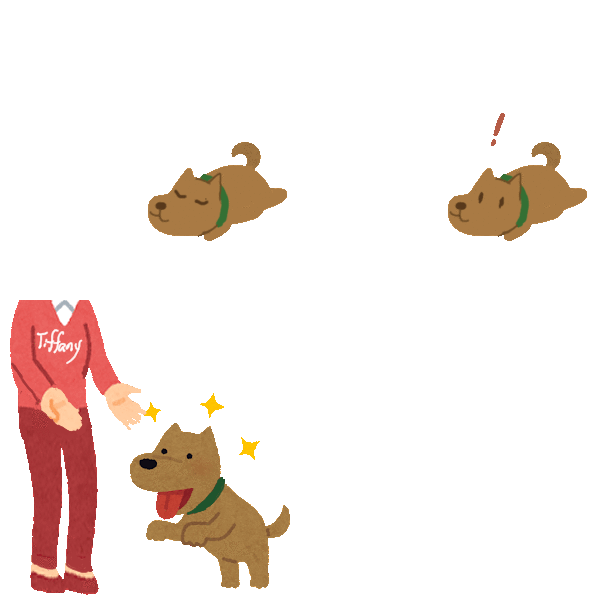
一 yī…就 jiù… links two actions: the moment the first one happens, the second one follows right away. It’s a lot like “as soon as” in English. It can also mean “every time,” when one thing always leads to another.
As soon as the first action happens, the second one follows. If both subjects are the same person, you can drop the second one.
我一看英文書书,就想睡覺睡觉
As soon as I start reading an English book, I want to sleep.
我一說说中文,朋友朋友就笑了
As soon as I spoke Chinese, my friend laughed.
Two different people, so the second subject (朋友 péngyǒu朋友 péngyou) goes before 就 jiù.
媽媽妈妈一下班,就回家
Mom goes home as soon as she gets off work.
他一看見看见她,就離開离开了
He left the moment he saw her.
他一聞到闻到臭豆腐,就想吐
The second he smells stinky tofu, he feels like throwing up.
Stinky tofuLet’s talk about one of the most famous (and most divisive) foods in Taiwan: stinky tofu! Why is it so stinky? It’s soaked in a special fermented brine, and that’s what gives it its famous smell and flavor. Some people can’t get enough of it.
The smell can be a lot at first, but trust me, it’s worth a try. Be bold! You might find your new favorite snack. And even if you hate it, at least you’ll have a great story about the time you ate one of the smelliest foods in the world. 😆
二 The Order Can’t Change
In English, “as soon as” can go at the start or in the middle of a sentence. In Chinese, the order is fixed: 一 yī part first, 就 jiù part second.
English: either order
I’ll go home as soon as I finish work. As soon as I finish work, I’ll go home.
Chinese: one order only
我一完成工作,就回家
The 一 part always comes first.
❌ 就回家,我一完成工作
✅ 我一完成工作,就回家
You can’t flip the two halves around like in English.
Tone change on 一Heads up: 一 changes its tone depending on the next syllable. Before a 4th-tone syllable it’s said yí (一看 yí kàn), and before 1st, 2nd or 3rd tones it’s said yì (一說一说yì shuō). The pinyin in the examples on this page shows the tone as it’s actually pronounced.
三 Every Time
一 yī…就 jiù… can also mean “every time.” The first part is a condition, and the second part is what always happens because of it.
我的狗一看到我,就很開心开心
Every time my dog sees me, she gets so happy.
爸爸一吃辣就拉肚子
Every time Dad eats spicy food, he gets diarrhea.
他一開始开始工作,就不會不会接電話电话
Once he starts working, he won’t answer the phone.
我一想到明天是星期一,就好想死
Whenever I think about tomorrow being Monday, I just want to die.
Just a joke! 😅
四 With a Negative
Subject + 一 + 沒没 + Verb,就 + ⋯
The first part can be negative too: “every time [something] doesn’t happen…”
我一沒没喝咖啡就頭痛头痛
Whenever I don’t drink coffee, I get a headache.
他一沒没睡飽睡饱,就脾氣脾气很大
Whenever he doesn’t get enough sleep, he’s in a terrible mood.
五 Common Mistakes
❌ 一我回家,就睡覺睡觉
✅ 我一回家,就睡覺睡觉
一 yī goes after the subject, right before the verb.
❌ 我一說说笑話笑话,就大家笑了
✅ 我一說说笑話笑话,大家就笑了
When the second subject is different, it goes before 就 jiù.
❌ 我一回家,睡覺睡觉
✅ 我一回家就睡覺睡觉
Don’t forget 就 jiù! 一 yī and 就 jiù work as a pair.
六 Practice
Tap the words below in the right order to build the sentence, then check your answer. If it’s wrong, you can try again as many times as you like, or hit “Show answer” if you get stuck. Careful: some tiles are traps and are not needed!
Question 1 of 10
“Every time I bring up the boss, I get angry.”
Tap words below to build the sentence
❌ Try Again
我一說到说到老闆老板就生氣生气
“Every time” meaning: the boss always leads to anger.
“Every day, he goes to bed as soon as he gets home.”
Tap words below to build the sentence
❌ Try Again
他每天一回家就去睡覺睡觉
Starting with 每天 měitiān is also correct.
Time words like 每天 měitiān go before 一 yī.
“I get nervous whenever I see a foreigner.”
Tap words below to build the sentence
❌ Try Again
我一看到外國人外国人就緊張紧张
Same person in both parts, so no second subject is needed.
“As soon as class ended, the students ran out.”
Tap words below to build the sentence
❌ Try Again
一下課下课,學生学生就跑出去了
學生一下課就跑出去了学生一下课就跑出去了 is also correct.
Here the first part has no subject, just 一 yī + event. The students go before 就 jiù.
“As soon as I got on the bus, it started to rain.”
Tap words below to build the sentence
❌ Try Again
我一上公車公交车,就下雨了
The rain started the moment I got on. Typical! ☔
“Every time my cat hears the fridge open, she comes running.”
Tap words below to build the sentence
❌ Try Again
我的貓猫一聽到听到冰箱打開打开的聲音声音就跑過來跑过来
A long object is fine: it all comes between 一 yī and 就 jiù.
“As soon as you get to the airport, call me.”
Tap words below to build the sentence
❌ Try Again
你一到機場机场就打電話給我给我打电话
The 一 yī part always comes first, even though English can put “as soon as” in the middle.
“Whenever she skips breakfast, she has no energy.”
Tap words below to build the sentence
❌ Try Again
她一沒没吃早餐就沒没力氣力气
一 yī + negative condition = “every time [she] doesn’t…”
“He falls asleep as soon as he gets on the plane.”
Tap words below to build the sentence
❌ Try Again
他一上飛機飞机就睡著睡着
A habit: every time he flies, the same thing happens.
“As soon as the teacher came in, everyone stopped talking.”
Tap words below to build the sentence
❌ Try Again
老師老师一進來进来,大家就不說話说话了
Two different subjects: 老師 lǎoshī老师 lǎoshī before 一 yī, 大家 dàjiā before 就 jiù.