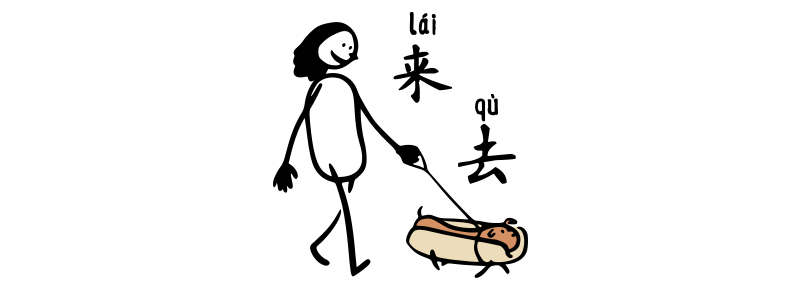
去 means “to go” and 來来lái means “to come” — basic movement words. But slot either one in front of another verb, and it starts signaling intention: a planned action or purpose, not just movement.
一 Structure
去 points away from the speaker, 來来 points toward the speaker. Put either one right before a second verb phrase to show what the trip is for.
Subject + 去 / 來来 + Verb + Object
我來見你我来见你
I’m coming to see you.
他去買买東西东西
He’s going shopping.
明天我不去上課上课
I’m not going to class tomorrow.
你要來台灣學中文嗎你要来台湾学中文吗?
Do you want to come to Taiwan to learn Chinese?
你們你们常一起去吃火鍋火锅嗎吗?
Do you often go eat hot pot together?
我昨天沒没去打籃球篮球
I didn’t go play basketball yesterday.
你要不要跟我一起去泡溫泉温泉?
Do you want to go to the hot springs with me?
二 Common Mistakes
❌ 我昨天不去打籃球篮球
✅ 我昨天沒没去打籃球篮球
Talking about something that already happened (or didn’t) needs 沒没, not 不 — the same rule that applies to every other verb applies to 去 here too.
三 Practice
Pick 去 or 來来lái to complete each sentence.
Question 1 of 10
他____買买東西东西。 (He’s going shopping.)
He’s heading away to shop, so it’s 去.
你要你要____台灣台湾學学中文嗎吗? (Do you want to come to Taiwan to learn Chinese?)
Taiwan is where the speaker is, so it’s 來来 — coming toward the speaker.
我____見见你。 (I’m coming to see you.)
The speaker is heading toward the listener, so it’s 來来.
你們你们常一起____吃火鍋火锅嗎吗? (Do you often go eat hot pot together?)
Heading out somewhere to eat is 去.
我昨天沒没____打籃球篮球。 (I didn’t go play basketball yesterday.)
Going out to play basketball is 去.
你要不要跟我一起____泡溫泉温泉? (Do you want to go to the hot springs with me?)
Heading out to the hot springs together is 去.
明天我不____上課上课。 (I’m not going to class tomorrow.)
Heading to class is 去.
你你____我家玩嗎吗? (Do you want to come hang out at my place?)
My place is where the speaker is, so it’s 來来.
他____學校学校上課上课。 (He’s going to school for class.)
Heading to school, away from the speaker, is 去.
媽媽妈妈____做飯饭給给我吃。 (Mom’s coming over to cook for me.)