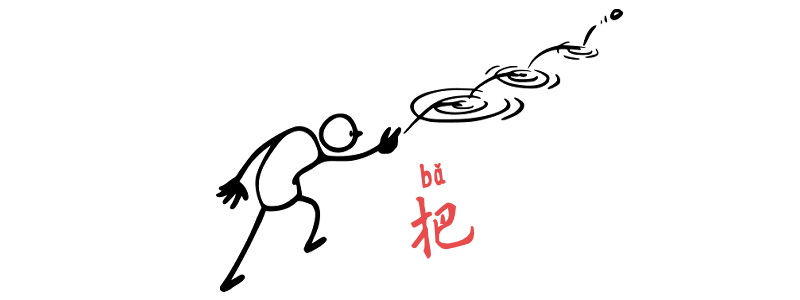
In every 把 bǎ把 bǎ sentence, the object always comes right after 把 bǎ把 bǎ, and something always has to follow the verb. What that “something” looks like is what separates the three structures below.
Before the formal rules — look at these three pictures. Can you guess what’s being said, just from the image?
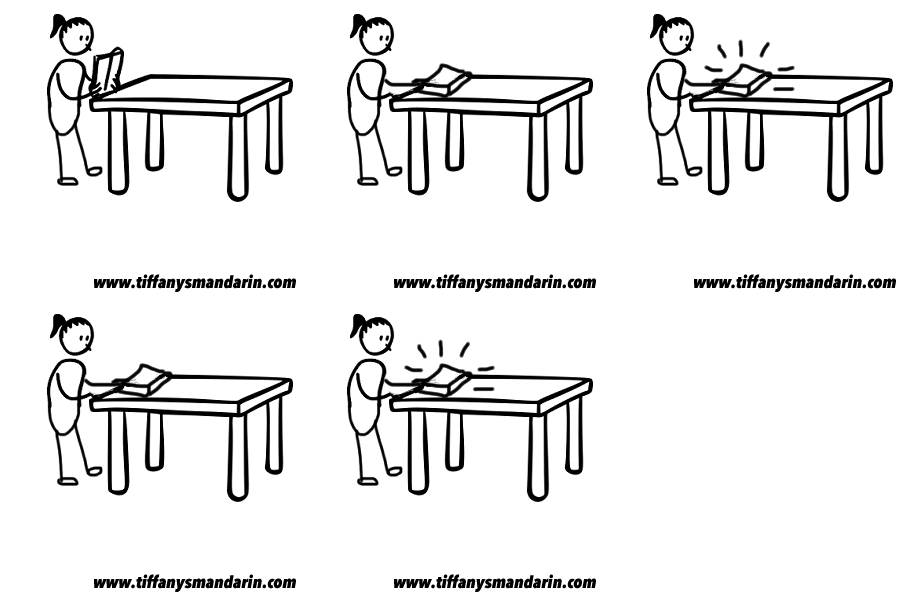
What is she doing with the book?
妹妹把書放在桌子上妹妹把书放在桌子上
My sister put the book on the table. (放在 fàngzài放在 fàngzài — the book now exists there.)
👆 Tap to reveal
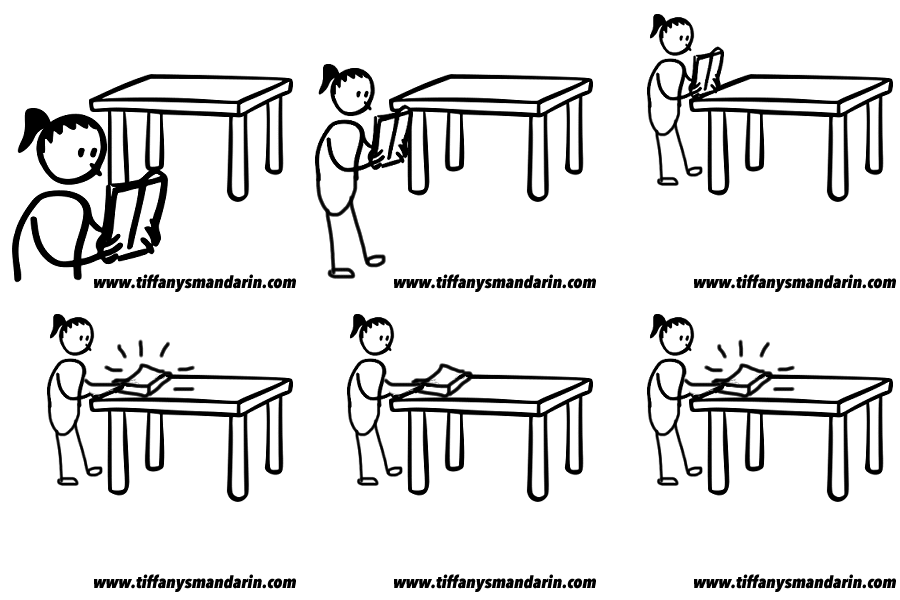
Same action, one word swapped — what changes?
妹妹把書放到桌子上妹妹把书放到桌子上
My sister put the book on the table. (放到 fàngdào放到 fàngdào — emphasizes the movement getting it there.)
👆 Tap to reveal
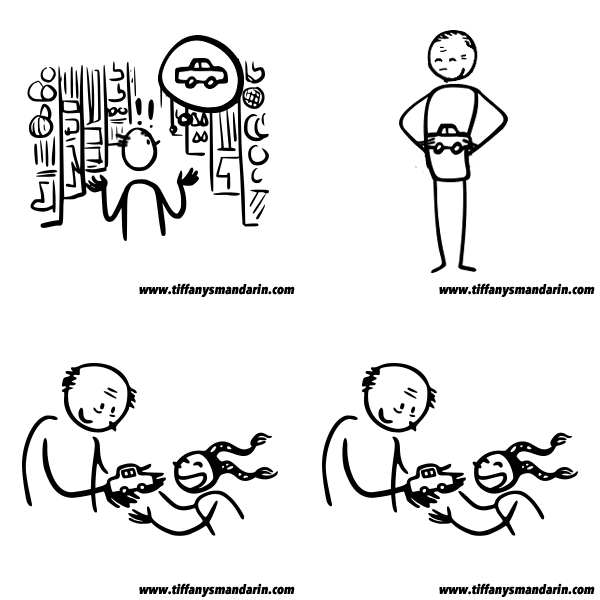
What is grandpa doing with the toy?
爺爺把新買的玩具送給了妹妹爷爷把新买的玩具送给了妹妹
Grandpa gave a new toy to my sister.
👆 Tap to reveal
In each one, the object — the book, the toy — sits right after 把 bǎ把 bǎ, with the verb and its details trailing behind. That’s the shape every 把 bǎ把 bǎ sentence takes.
1 Structure
(1) Subject + 把 bǎ把 bǎ + Object + Verb + 在 zài在 zài / 到 dào到 dào + Location
在 zài在 zài focuses on the object ending up existing somewhere. 到 dào到 dào usually needs a movement to get there. Common verbs with 在 zài在 zài: 放 fàng放 fàng (put), 掛 guà挂 guà (hang), 收 shōu收 shōu (take in).
你把外套掛在衣櫥裡你把外套挂在衣橱里
You hung the coat in the closet.
她把行李搬到樓上她把行李搬到楼上
She moved the luggage upstairs.
你不能把車停到公司前面你不能把车停到公司前面
You cannot park your car in front of the office.
我應該現在把東西寄到美國嗎我应该现在把东西寄到美国吗
Should I send my stuff to the US now?
我把錢收在抽屜裡我把钱收在抽屉里
I put the money away in the drawer.
(2) Subject + 把 bǎ把 bǎ + Object 1 + Verb (+ 給 gěi给 gěi) + Object 2
For a transfer of possession — Object 1 is what’s being handed over, Object 2 is who receives it. Common verbs:送 sòng送 sòng (give), 拿 ná拿 ná (take), 遞 dì递 dì (hand), 賣 mài卖 mài (sell), 借 jiè借 jiè (lend), 還 huán还 huán (return), 介紹 jièshào介绍 jièshào (introduce), 寄 jì寄 jì (send).
爺爺把新買的玩具送給了妹妹爷爷把新买的玩具送给了妹妹
Grandpa gave a new toy to my sister.
我不想把禮物拿給他我不想把礼物拿给他
I don’t want to give him a gift.
我真的不該把錢借給朋友我真的不该把钱借给朋友
I really shouldn’t lend money to friends.
你可以把這本書還給圖書館嗎你可以把这本书还给图书馆吗
Could you return this book to the library?
(3) Subject + 把 bǎ把 bǎ + Object + Verb + Result / Direction / State Complement
Result complements (完 wán完 wán/開 kāi开 kāi etc.) show the verb’s outcome; direction complements (下來 xiàlái下来 xiàlái, 出去 chūqù出去 chūqù etc.) show which way something moves; state complements (using 得 de得 de) describe the resulting condition.
你快把藥吃完你快把药吃完
You should finish your medicine quickly. (Result complement.)
誰把我的信打開了谁把我的信打开了
Who opened my letter? (Result complement.)
媽媽把衣服洗得非常乾淨妈妈把衣服洗得非常干净
Mom washed the clothes very clean. (State complement, using 得 de得 de.)
孩子把褲子脫下來孩子把裤子脱下来
The child took off his pants. (Direction complement.)
把錢全部拿出來把钱全部拿出来
Take out all the money. (Direction complement.)
你等一下記得把垃圾拿下去你等一下记得把垃圾拿下去
Please remember to take the garbage down later. (Direction complement.)
2 Common Mistakes
❌
我把咖啡喝在咖啡店我把咖啡喝在咖啡店
I drink my coffee in a coffee shop. Drinking coffee doesn’t make the coffee “exist” somewhere the way 放 fàng放 fàng/掛 guà挂 guà/收 shōu收 shōu do — 在 zài在 zài only pairs with verbs that place an object into a location.
❌
請你把一杯水拿給我请你把一杯水拿给我
✅
請你把那杯水拿給我请你把那杯水拿给我
Please bring me that glass of water. 把 bǎ把 bǎ only works for something specific — both speaker and listener need to already know which object it is. “A glass of water” is too vague; “that glass” or “the” makes it specific.
❌
我把他愛了我把他爱了
I loved him. 把 bǎ把 bǎ describes doing something to an object that changes it — feelings like love, hate, or fear can’t be expressed this way.
❌
哥哥把筆不放在桌上哥哥把笔不放在桌上
✅
哥哥不把筆放在桌上哥哥不把笔放在桌上
My brother does not put the pen on the table. Negation words and adverbs always sit in front of 把 bǎ把 bǎ, never between 把 bǎ把 bǎ and the object.
3 Practice
Translate each English sentence into a 把 bǎ把 bǎ sentence, then tap the card to check your answer.
01Please hang the coat on the hanger.
請把外套掛在衣架上请把外套挂在衣架上
Please hang the coat on the hanger.
👆 Tap to reveal
02He handed the documents to the manager.
他把文件遞給了經理他把文件递给了经理
He handed the documents to the manager.
👆 Tap to reveal
03Please drink up the soup.
請把湯喝完请把汤喝完
Please drink up the soup.
👆 Tap to reveal
04Take off your shoes.
把鞋子脫下來把鞋子脱下来
Take off your shoes.
👆 Tap to reveal
05Don’t put your bag on the table.
不要把包包放在桌子上不要把包包放在桌子上
Don’t put your bag on the table.
👆 Tap to reveal
06He sold the car to a stranger.
他把車賣給了一個陌生人他把车卖给了一个陌生人
He sold the car to a stranger.
👆 Tap to reveal
07Put the trash can outside.
把垃圾桶放到外面把垃圾桶放到外面
Put the trash can outside.
👆 Tap to reveal
08I introduced my friend to my mom.
我把朋友介紹給了我媽媽我把朋友介绍给了我妈妈
I introduced my friend to my mom.
👆 Tap to reveal
09She wiped the table very clean.
她把桌子擦得非常乾淨她把桌子擦得非常干净
She wiped the table very clean.
👆 Tap to reveal
10Take the umbrella upstairs.
把傘拿上去把伞拿上去
Take the umbrella upstairs.
👆 Tap to reveal
