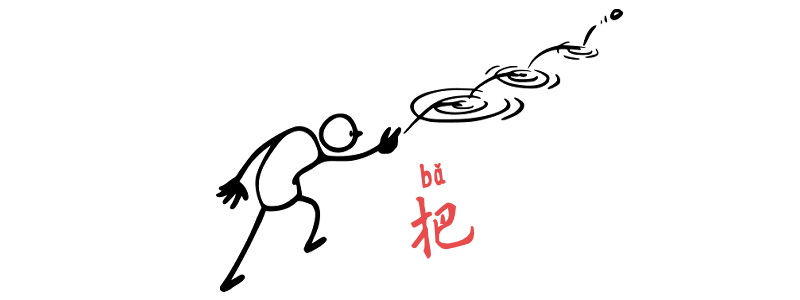
These two patterns look different on the surface, but both still follow the basic 把 bǎ把 bǎ logic:the object comes right after 把 bǎ把 bǎ, and something meaningful follows the verb.
1 Structure
(1) 看 kàn看 kàn / 瞧 qiáo瞧 qiáo + 把 bǎ把 bǎ + Object (Agent) + X 得 de得 de…
看 kàn看 kàn or 瞧 qiáo瞧 qiáo opens the sentence as an exclamation — “look at” or “just look at” — pointing at someone’s state, usually with a hint of surprise, amusement, or mock complaint. 得 de得 de… describes just how far that state has gone.
看把你高興得像個孩子一樣看把你高兴得像个孩子一样
Look how happy you are — just like a kid.
瞧把他緊張得話都說不清楚了瞧把他紧张得话都说不清楚了
Look how nervous he is — he can’t even get his words out.
看把孩子餓得飯一上桌就開吃了看把孩子饿得饭一上桌就开吃了
Look how hungry the kid is — he started eating the moment the food hit the table.
瞧把她氣得臉都紅了瞧把她气得脸都红了
Look how mad she is — her face has gone red.
Tone
This pattern almost always carries an emotional charge — surprise, amusement, sympathy, or a gentle scolding. It’s rarely neutral, and it sounds distinctly conversational.
(2) Subject + 把 bǎ把 bǎ + Object 1 + Verb + 成 chéng成 chéng + Object 2
This means turning Object 1 into Object 2. It splits into three uses:a real physical transformation, an abstract reframing, and describing something being mistaken for something else.
Real Action
妹妹把火雞切成了12份妹妹把火鸡切成了12份
My sister cut the turkey into 12 portions.
我把中文文法分成了六級我把中文语法分成了六级
I divided the Chinese grammar into six levels.
我還把我的中文知識做成了影片我还把我的中文知识做成了视频
I also made my Chinese knowledge into videos.
師傅把木頭雕成了一隻鳥师傅把木头雕成了一只鸟
The craftsman carved the wood into a bird.
Abstract Verb
我要把這個房間當成我的工作室我要把这个房间当成我的工作室
I want to use this room as my studio.
你可以把這個PDF檔轉成Word檔嗎你可以把这个PDF档转成Word档吗
Can you convert this PDF file into a Word file?
他把失敗當成學習的機會他把失败当成学习的机会
He treats failure as a learning opportunity.
老師把每個學生都看成自己的孩子老师把每个学生都看成自己的孩子
The teacher sees every student as her own child.
Mistaken Perception
Used when something is mistaken for something else — mishearing, misspelling, or visual mix-ups. Object 1 is the real thing; Object 2 is what it got mistaken for.
我把你的聲音聽成你媽媽的聲音我把你的声音听成你妈妈的声音
I misheard your voice as your mother’s voice.
媽媽把kitchen說成chicken妈妈把kitchen说成chicken
Mom accidentally said “kitchen” as “chicken.”
你把「天」寫成「夫」了你把“天”写成“夫”了
You miswrote “heaven” (天 tiān天 tiān) as “husband” (夫 fū夫 fū).
我把「未」看成了「末」我把“未”看成了“末”
I misread “not yet” (未 wèi未 wèi) as “end” (末 mò末 mò).
2 Practice
Translate each English sentence into a 把 bǎ把 bǎ sentence, then tap the card to check your answer.
01Look how excited she is — she can’t sit still.
看把她興奮得坐不住了看把她兴奋得坐不住了
Look how excited she is — she can’t sit still.
👆 Tap to reveal
02Look how tired he is — he fell asleep standing up.
瞧把他累得站著都能睡著瞧把他累得站着都能睡着
Look how tired he is — he could fall asleep standing up.
👆 Tap to reveal
03The chef turned the fruit into a beautiful sculpture.
廚師把水果做成了一件漂亮的雕塑厨师把水果做成了一件漂亮的雕塑
The chef turned the fruit into a beautiful sculpture.
👆 Tap to reveal
04He treats every setback as a lesson.
他把每次挫折都當成一課他把每次挫折都当成一课
He treats every setback as a lesson.
👆 Tap to reveal
05Look how nervous the bride is — her hands are shaking.
看把新娘緊張得手都抖了看把新娘紧张得手都抖了
Look how nervous the bride is — her hands are shaking.
👆 Tap to reveal
06I misread “cause” as “cure.”
我把cause看成了cure我把cause看成了cure
I misread “cause” as “cure.”
👆 Tap to reveal
07Look at him, so proud he can barely stop grinning.
瞧把他驕傲得,嘴都合不攏了瞧把他骄傲得,嘴都合不拢了
Look how proud he is — he can’t stop grinning.
👆 Tap to reveal
08The company turned the old warehouse into a cafe.
公司把舊倉庫改成了一間咖啡廳公司把旧仓库改成了一间咖啡厅
The company turned the old warehouse into a cafe.
👆 Tap to reveal
09He mistook the stranger for his old classmate.
他把那個陌生人認成了老同學他把那个陌生人认成了老同学
He mistook the stranger for his old classmate.
👆 Tap to reveal
10Look how worried mom is — she’s called me five times.
看把媽媽擔心得,打了五次電話看把妈妈担心得,打了五次电话
Look how worried mom is — she’s called me five times.
👆 Tap to reveal
