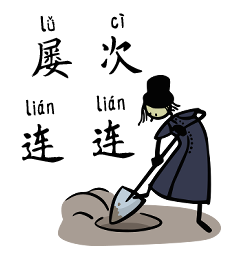
連連 liánlián连连 liánlián is flexible about position — it can sit before the verb, or stand after a noun as the whole predicate. 屢次 lǚcì屡次 lǚcì is stricter: it always comes right before a verb phrase, and it leans toward describing something repeated and unwelcome — a warning ignored, a rule broken again and again.
1 Structure
連連 liánlián连连 liánlián + V
Sits right before the verb, describing a rapid string of the same reaction — nodding, shaking one’s head, thanking, praising — happening several times in quick succession.
他連連點頭表示同意他连连点头表示同意
He nodded repeatedly to show agreement.
聽到這個消息,大家連連搖頭听到这个消息,大家连连摇头
Hearing this news, everyone shook their heads again and again.
她連連道謝,感激不已她连连道谢,感激不已
She thanked him again and again, endlessly grateful.
老師連連稱讚他的表現老师连连称赞他的表现
The teacher praised his performance again and again.
N + 連連 liánlián连连 liánlián
連連 liánlián连连 liánlián can also stand on its own as the whole predicate, right after a noun, meaning “one after another.” This is something 屢次 lǚcì屡次 lǚcì can never do.
這場演出掌聲連連这场演出掌声连连
This performance received applause after applause.
新手上路,失誤連連新手上路,失误连连
A beginner on the road, mistakes came one after another.
這趟旅行驚喜連連这趟旅行惊喜连连
This trip was full of surprise after surprise.
派對上笑話連連,氣氛非常熱鬧派对上笑话连连,气氛非常热闹
Jokes came one after another at the party, and the atmosphere was very lively.
S + 屢次 lǚcì屡次 lǚcì + VP
Always sits before the verb phrase. It describes something happening on numerous separate occasions, often over an extended period, and often carries a negative charge — a warning, a violation, a failure, repeated.
他屢次警告對方,但對方毫不理會他屡次警告对方,但对方毫不理会
He repeatedly warned the other party, but they completely ignored it.
這名員工屢次遲到,最終被解僱这名员工屡次迟到,最终被解雇
This employee was repeatedly late, and was eventually fired.
儘管屢次失敗,他依然沒有放棄尽管屡次失败,他依然没有放弃
Despite repeated failures, he still didn’t give up.
該公司屢次違反環保法規该公司屡次违反环保法规
This company has repeatedly violated environmental regulations.
他屢次嘗試聯絡對方,卻始終得不到回應他屡次尝试联络对方,却始终得不到回應
He repeatedly tried to contact the other party, but never got a response.
Bonus: 屢次三番 lǚcìsānfān屡次三番 lǚcìsānfān
This four-character set phrase pairs 屢次 lǚcì屡次 lǚcì with 三番 sānfān (“three times over”) for extra emphasis — “time and again,” stressing just how persistent the repetition has been.
他屢次三番地要求加薪,老闆終於答應了他屡次三番地要求加薪,老板终于答应了
He asked for a raise time and again, and the boss finally agreed.
2 Common Mistakes
The two get confused because they both mean “repeatedly” — but the timeframe and the sentence shape don’t match.
❌
他去年連連遲到,老闆很生氣他去年连连迟到,老板很生气
✅
他去年屢次遲到,老闆很生氣他去年屡次迟到,老板很生气
連連 liánlián连连 liánlián pictures a quick burst, not events scattered across a whole year. 屢次 lǚcì屡次 lǚcì is the right fit for repetition spread over time.
❌
這場比賽精彩屢次这场比赛精彩屡次
✅
這場比賽精彩連連这场比赛精彩连连
屢次 lǚcì屡次 lǚcì always needs a verb phrase after it — it can’t stand alone as a predicate. Only 連連 liánlián连连 liánlián can follow a noun this way.
3 連連连连 vs 屢次屡次
A quick side-by-side of the two words.
|
連連 liánlián连连 liánlián |
屢次 lǚcì屡次 lǚcì |
| Picture |
A quick burst, several times in a row, in the moment |
Occurrences spread out over time, on separate occasions |
| Position |
Before V, or standing alone as predicate after N |
Only before a verb phrase |
| Tone |
Often neutral or positive (praise, surprises, applause) |
Often negative (violations, failures, ignored warnings) |
| Set phrase |
— |
屢次三番 lǚcìsānfān屡次三番 lǚcìsānfān |
4 Practice
Translate each sentence into Chinese, then tap the card to check your answer.
01He nodded repeatedly, seeming very satisfied.
他連連點頭,似乎很滿意他连连点头,似乎很满意
👆 Tap to reveal
02This company has repeatedly ignored the regulator’s warnings.
這家公司屢次無視監管機構的警告这家公司屡次无视监管机构的警告
👆 Tap to reveal
03Bad news came one after another, and everyone felt anxious.
壞消息連連,大家都感到不安坏消息连连,大家都感到不安
👆 Tap to reveal
04He repeatedly tried this experiment, but it failed every time.
他屢次嘗試這個實驗,但每次都失敗了他屡次尝试这个实验,但每次都失败了
👆 Tap to reveal
05She shook her head repeatedly, expressing her disagreement.
她連連搖頭,表示不同意她连连摇头,表示不同意
👆 Tap to reveal
06This team has repeatedly missed the deadline.
這個團隊屢次錯過截止日期这个团队屡次错过截止日期
👆 Tap to reveal
07This year’s harvest brought good news one after another.
今年的收成好消息連連今年的收成好消息连连
👆 Tap to reveal
08He repeatedly asked her out, but she kept refusing.
他屢次約她出去,但她一直拒絕他屡次约她出去,但她一直拒绝
👆 Tap to reveal
09The judges praised this performance again and again.
評審連連稱讚這場表演评审连连称赞这场表演
👆 Tap to reveal
10Despite repeated setbacks, this team never gave up.
儘管屢次遭遇挫折,這支隊伍從未放棄尽管屡次遭遇挫折,这支队伍从未放弃
👆 Tap to reveal
