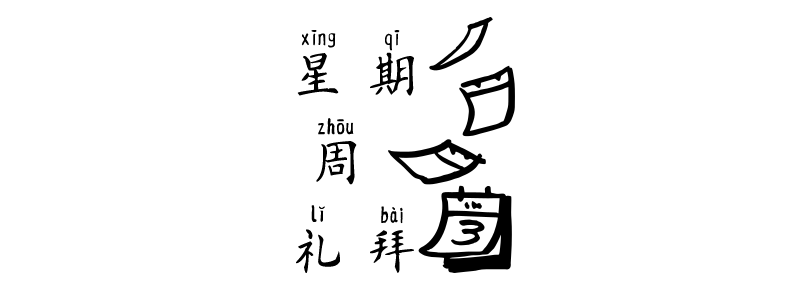
In Chinese, “day” is 日 rì or 天 tiān, and “week” is 週 zhōu周 zhōu, 禮拜 lǐbài礼拜 lǐbài, or 星期 xīngqí星期 xīngqī.
1Number + 天 tiān / 日 rì
天 tiān is the everyday word for “day.” 日 rì is less common in everyday speech. It sounds more formal or poetic, and it is often seen in writing, literature, historical contexts, or formal expressions. Neither one needs a measure word.
Number + 天 tiān / 日 rì
兩天两天
two days
三天兩夜三天两夜
three days and two nights
這需要五個工作日这需要五个工作日
This will take five business days.
我們公司的貨提供7天鑑賞期我们公司的货提供7天无理由退货
Our company’s products come with a seven-day cooling-off period.
Key Point
In 工作日 gōngzuòrì (“business day”), the 個 ge个 ge is there because 工作日 gōngzuòrì is a noun, not because of 日 rì itself.
Culture Note: The Seven-Day Cooling-Off Period
The “seven-day cooling-off period” (七天鑑賞期 qī tiān jiànshǎngqí七天鉴赏期 qī tiān jiànshǎngqī) is part of Taiwan’s Consumer Protection Law. For online shopping and some other kinds of purchases, it lets you return an item within seven days, no questions asked.
It’s meant for checking the item — making sure it’s complete and undamaged — not for trying it out. To get a full refund, the item usually needs to come back unused and in its original packaging. Mainland China has a similar rule, commonly called 七天無理由退貨 qī tiān wú lǐyóu tuìhuò七天无理由退货 qī tiān wú lǐyóu tuìhuò, “seven-day no-reason returns.”
2Number + 週 zhōu周 zhōu / 個 ge个 ge + 禮拜 lǐbài礼拜 lǐbài / 個 ge个 ge + 星期 xīngqí星期 xīngqī
禮拜 lǐbài礼拜 lǐbài and 星期 xīngqí星期 xīngqī require the measure word 個 ge个 ge, while 週 zhōu周 zhōu does not.
Number + 週 zhōu周 zhōu
Number + 個 ge个 ge + 禮拜 lǐbài礼拜 lǐbài / 星期 xīngqí星期 xīngqī
📌 Want to know the difference between these three words? Check out Days of the Week in Chinese.
三個星期三个星期
three weeks
聖誕節我們要休息兩週圣诞节我们要休息两周
We’re taking a two-week break for Christmas.
你們哪個禮拜有空?你们哪个礼拜有空?
Which week are you free?
一個星期有七天一个星期有七天
A week has seven days.
我每個禮拜都去教會我每个礼拜都去教会
I go to church every week.
3上 shàng / 下 xià + Week
上 shàng means “previous” or “above.” With a word for “week,” it refers to the week before this one. 下 xià means “next” or “below,” and refers to the week after this one. Double it — 上上 shàngshàng or 下下 xiàxià — to go back or forward two weeks.
| Last | This | Next |
|---|
| 週 zhōu周 zhōu | 上週 shàngzhōu上周 shàngzhōu | 這週 zhèzhōu这周 zhèzhōu | 下週 xiàzhōu下周 xiàzhōu |
| 禮拜 lǐbài礼拜 lǐbài | 上(個)禮拜 shàng (ge) lǐbài上(个)礼拜 shàng (ge) lǐbài | 這(個)禮拜 zhè (ge) lǐbài这(个)礼拜 zhè (ge) lǐbài | 下(個)禮拜 xià (ge) lǐbài下(个)礼拜 xià (ge) lǐbài |
| 星期 xīngqí星期 xīngqī | 上(個)星期 shàng (ge) xīngqí上(个)星期 shàng (ge) xīngqī | 這(個)星期 zhè (ge) xīngqí这(个)星期 zhè (ge) xīngqī | 下(個)星期 xià (ge) xīngqí下(个)星期 xià (ge) xīngqī |
這週这周
this week
下禮拜下礼拜
next week
上星期上星期
last week
下下週下下周
the week after next
上上禮拜五上上礼拜五
the Friday before last
Good to Know
With 禮拜 lǐbài礼拜 lǐbài and 星期 xīngqí星期 xīngqī, you can add 個 ge个 ge after 上 shàng / 下 xià / 這 zhè这 zhè — both 上星期 shàng xīngqí上星期 shàng xīngqī and 上個星期 shàng ge xīngqí上个星期 shàng ge xīngqī are correct. 週 zhōu周 zhōu never takes 個 ge个 ge.
4Common Mistakes
✅三個禮拜三个礼拜
When counting weeks, 禮拜 lǐbài礼拜 lǐbài and 星期 xīngqí星期 xīngqī need 個 ge个 ge.
❌兩個週两个周 or 上個週上个周
✅兩週两周 or 上週上周
週 zhōu周 zhōu never takes 個 ge个 ge — not when counting, and not after 上 shàng or 下 xià.
❌我三天工作了
✅我工作了三天
A length of time goes after the verb.
5Practice
Translate each sentence into Chinese, then tap the card to check your answer.
01Next week, we only have to work for three days.
下禮拜只要工作3天下礼拜只要工作3天
👆 Tap to reveal
02I spent two weeks traveling in China.
我在中國玩了2個星期我在中国玩了2个星期
👆 Tap to reveal
03Would you like to have dinner together on the Friday after next?
你下下禮拜五要一起吃飯嗎?你下下礼拜五要一起吃饭吗?
👆 Tap to reveal
04He rests two days every week.
他每個星期休息兩天他每个星期休息两天
👆 Tap to reveal
05We’re going to Japan for five days and four nights.
我們要去日本玩五天四夜我们要去日本玩五天四夜
👆 Tap to reveal
06See you next week!
下週見!下周见! or 下禮拜見!下礼拜见!
👆 Tap to reveal
07I didn’t go to work last Wednesday.
我上個星期三沒去上班我上个星期三没去上班
👆 Tap to reveal
08My mom is coming to see me the week after next.
我媽媽下下個禮拜要來看我我妈妈下下个礼拜要来看我
👆 Tap to reveal
