MANDARIN TRAVEL PHRASES · SCENE 09
BOARDING PASS TO MANDARIN
Cultural Reminders
文化提醒文化提醒Tipping norms, queueing etiquette, temple manners, gift-giving, street smarts, and what not to say — the unwritten rules that don’t show up in a phrasebook.
Tipping
Queueing
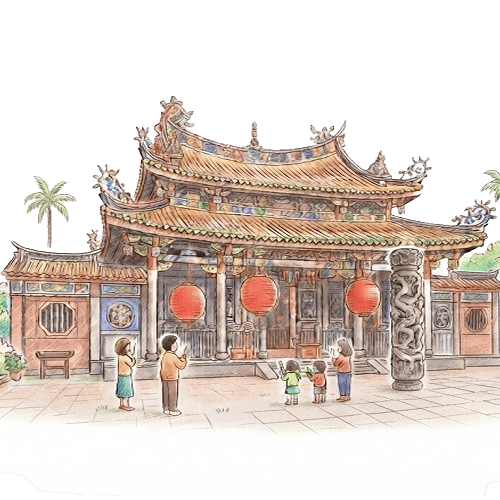
Temples
Gifts
Taboos
Street Smarts
Region
Pinyin
Translation
01
💵
Tipping Norms
- Neither Taiwan nor mainland China has a tipping culture for restaurants, taxis, or hotels — leaving extra money can even confuse or fluster the staff.
- High-end hotel bellhops and guides on small private tours are the exceptions — a small tip there is appreciated but still never required.
- Service charges are sometimes already built into the bill at nicer restaurants (often listed as 服務費) — check before adding anything extra.
Key Phrase
不用不用找了找了Keep the change — about as close as it gets to a “tip” phrase
02
🚶
Queueing Etiquette
- Queuing is taken seriously in Taiwan — cutting in line is a real faux pas, even for something as small as an ATM or a convenience store register.
- In mainland China, queue discipline varies more by city and situation — crowding can happen at peak times, though it’s improved a lot in major cities in recent years.
- On escalators, stand to one side (right in Taiwan) and leave the other side clear for walkers — and let people exit a train before you board.
Key Phrase
請请排隊排队Please line up — a polite, useful line if someone tries to cut ahead
03
⛩
Temple Manners
- Dress modestly (shoulders and knees covered) and keep your voice down once you’re inside.
- Step over the threshold at the main gate rather than directly on it — stepping on it is considered disrespectful in traditional belief.
- Photography is often fine in courtyards but can be restricted directly in front of the main altar — check for signage or ask a staff member first.
Key Phrase
這裡这里可以可以拍照拍照嗎吗?Is it okay to take photos here? — always worth asking before you raise your camera in a temple
04
🎁
Gift-Giving
- Avoid clocks as gifts — 送鐘 (sòng zhōng, “giving a clock”) sounds identical to 送終 (sòng zhōng, seeing someone off at their death). Sharp objects like scissors or knives are also avoided, since they can symbolize “cutting” a relationship.
- Giving gifts in pairs (even numbers) is considered lucky — except four, since 四 (sì, “four”) sounds like 死 (sǐ, “death”).
- It’s polite to decline a gift once or twice before accepting it — the giver is expected to insist, and both sides play along.
Key Phrase
這是这是給你的给你的一點一点小心意小心意This is just a small token for you — the humble way to present a gift
05
🚫
What Not to Say
- Avoid the number four (四, sì) where you have a choice — in gift quantities, room numbers, floor numbers. Many buildings skip a labeled 4th floor, the way Western buildings sometimes skip 13.
- Casual conversation tends to steer around death, serious illness, and funerals — especially around elders. It’s not that these topics are forbidden, just not typical small talk.
- Directly comparing mainland China and Taiwan politically is a sensitive subject — best left alone with people you’ve just met.
- Blunt criticism of someone’s home, city, family, or country in front of others can cause them to lose face (面子, miànzi) — frame concerns gently, and ideally in private.
06
🛺
Street Smarts
- You’ll often see metal barrels on sidewalks or outside shops used for burning joss paper (金紙, jīnzhǐ) as offerings — that’s not a trash can, even though it might look like one.
- Cross streets carefully — plenty of cars, scooters, and buses don’t reliably yield to pedestrians even at marked crossings. Make eye contact with drivers when you can, and don’t assume a green light means it’s safe to step out.
Cultural Cheat Sheet
Screenshot or print to keep on hand
Enjoying this site?
This project is free and made in my spare time. If it helped you navigate a tricky moment with more confidence, a coffee goes a long way toward keeping new scenarios coming.
☕ Buy me a coffee
1 thought on “Chinese Cultural Reminders”
Comments are closed.