Renting an Apartment in Taiwan房屋租赁 Fángwū zūlìn
Every term a landlord, an agent, or a lease might throw at you — sorted so you can actually find the one you need, with the traps foreign tenants fall into most often.
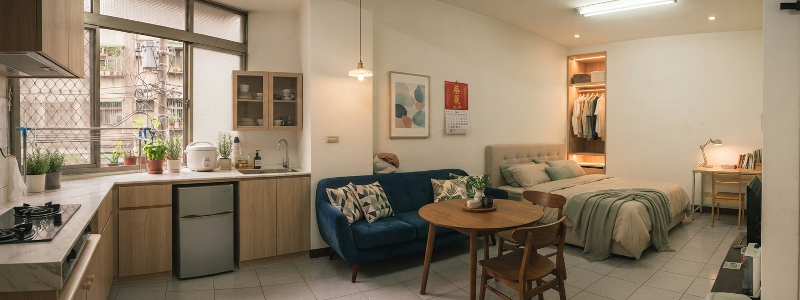
I know this photo isn’t exactly pretty — but this is genuinely what most people’s apartments look like. Unless you have a fairly high budget, housing in Taipei really is expensive and small.
Renting an apartment in Taiwan can be a confusing and frustrating experience. I strongly recommend that you take a Taiwanese friend with rental experience along with you. This can save you trouble if your landlord (房东 Fángdōng) tries to use tricky contract terms or hide issues with the apartment.
House types房屋类型
Taiwanese listings sort housing by layout and building type, not bedroom count the way Western listings do. Knowing these seven terms will save you from viewing five apartments that were never what you asked for.
If you’re renting in mainland China instead
Cross the strait and the listing terms change — some overlap with Taiwan, some don’t exist there at all. Worth knowing both sets if you might end up house-hunting on either side.
- 整租 (zhěngzū) — you rent the whole place yourself. Highest privacy, highest rent.
- 合租 (hézū) — your own room, shared common areas. The most popular option with students and young professionals.
- 单身公寓 (dānshēn gōngyù) — a small self-contained space for one, usually furnished.
- 公寓式酒店 (gōngyùshì jiǔdiàn) — front desk, cleaning, and management service. Higher rent; best suited to a temporary work posting.
Rooms & spaces
顶楼加盖 rooftop additions run cheap for a reason
These illegal rooftop units aren’t built to code. Most have tin roofs that turn into ovens in summer and drums during a rainstorm, and utilities are often shared — and split unevenly — with the unit downstairs.
Special needs特殊需求
What to actually ask about before you commit — most of these won’t be volunteered by the landlord unless you bring them up first.
Problems that could happen可能发生的问题
Top-floor rooms in Taiwan can leak badly when it rains. The simplest way to check is to view the apartment on a rainy day rather than take the landlord’s word for it.
Disfigured, bubbling concrete on a wall — a sign of high humidity and water intrusion. It feeds mold that’s bad for your health and your furniture, and it usually means running a dehumidifier or A/C around the clock, which shows up on your electricity bill.


Land is expensive, so walls between units are often thin. A neighbor running the washing machine at midnight can absolutely wake you. Keep a pair of earplugs on hand.
Unless you live in a 大楼 dàlóu with collection built in, you’ll need to carry your trash out and physically catch the yellow garbage truck yourself.
Before you sign: red flags to check签约前检查
A few extra minutes at the viewing can save you a deposit fight later. Foreign tenants especially get rushed through this step — slow it down.
- ID match — ask to see the landlord’s ID or the household registration and confirm the name matches the person signing the contract. Subletting without the owner’s knowledge is a real risk.
- Photograph everything — scuffs, stains, cracked tile, a wobbly door — before you move a single box in. Timestamped photos are your evidence at move-out.
- Ask which electricity meter it is — a shared/resale meter (see Fees) can quietly double your summer bill.
- Get the deposit terms in writing — how much is refundable, and under what conditions it can be withheld.
- Check for a rooftop addition next door — an illegal rooftop structure above or beside you can mean shared, disputed utility lines.
- Ask about early termination — Taiwan’s standard is one month’s notice; confirm your contract doesn’t quietly demand more.
- Request the standard lease template — Taiwan’s Ministry of the Interior publishes a standard rental contract with tenant protections built in; a landlord unwilling to use anything close to it is worth a second look.
Useful terms from this checklist
Fees費用
You can’t deduct it from your taxes. It’s technically illegal, but roughly four in five landlords don’t report rental income — which is exactly why they resist letting you claim the deduction. The minority who do report their income tend to price the extra tax into your rent.
Usually 1–2 months’ rent. Returned at the end of the contract, minus anything owed for damage beyond normal wear.
Billed every two months. Often folded into rent since it’s cheap.
Summer rates run higher than winter. There are two meter setups: an independent meter (独立电表, dúlì diànbiǎo), where Taipower bills you directly at the standard tiered rate — no landlord markup — versus a flat resale rate (一度5块, yídù 5 kuài), where the landlord charges a flat ~5 NT per kWh regardless of usage tier. Which one you get isn’t negotiable — it’s a property of the unit, not something you can talk a landlord out of.
Cheap, like the water bill — not worth worrying about.
Scales with the size of shared facilities and the number of guards on staff — typically in the tens of NT dollars per 坪 per month, climbing much higher for luxury buildings.
A modest monthly cost. If you’d rather skip a separate line, an unlimited phone data plan can double as a home hotspot.
If you find the place through a real estate agent, expect a fee around half to one month’s rent.
Others you need to know其他须知
Room size measure word — 坪 Píng
All floor sizes in Taiwan are quoted in ping, not square meters. One ping ≈ 3.3 m² ≈ 35.5 ft² — worth memorizing so listings actually mean something to you.
Breach of contract — 违约 Wéiyuē
Ending a lease early requires one month’s notice to the landlord. Give proper notice and you’ll typically get 50–70% of your deposit back; skip it and the landlord can usually keep the whole thing.
Who fixes what — 东西坏了 Dōngxī huàile
Major appliances — A/C, fridge, water heater, TV, washing machine, and furniture — are the landlord’s responsibility to repair. Small stuff like a clogged toilet or a dead light bulb is on you.
Viewing an apartment: key lines看房实用句
The questions worth asking out loud during a viewing, in the order a landlord expects to hear them.
請問是獨立電表還是分租電表?请问是独立电表还是分租电表?
水費和網路費包含在租金裡面嗎?水费和网络费包含在租金里面吗?
這裡會漏水嗎?这里会漏水吗?
押金可以退多少?押金可以退多少?
可以用制式化合約嗎?可以用定型化契约吗?
Notes for foreign tenants外国房客须知
- Bring your ARC — most landlords will ask for your Alien Resident Certificate at signing, not just a passport.
- A guarantor may be requested — some landlords, especially outside major cities, ask a foreign tenant for a local guarantor or a larger deposit in place of one — this is negotiable, not universal.
- 591.com is Chinese-only but is where the inventory is — a translation browser extension or your phone’s built-in translate-camera makes it usable even at an early level.
- Read the contract slowly — ask for a day to take it home, or photograph it and go through it with a Taiwanese friend or teacher before signing.
- Facebook rental groups fill in the gaps — shared houses and short leases are often posted there before they ever reach a listing site.
Useful terms from this checklist
Where to find a house哪里找房
In Taiwan
- 591.com.tw Chinese only, but it’s what local people use — and it’s cheaper than the English-facing alternatives.
- Taipei Apartment Rental Network English-language listings aimed at expats and short-term renters in Taipei.
- Facebook rental groups Search for the group covering the specific county or district you want — this is especially true for shared houses, which rarely make it onto listing sites at all.
In mainland China
- 贝壳 (Beike) A large, well-known platform for both buying and renting — owns Lianjia and pools listings from agents nationwide.
- 鏈家 (Lianjia) One of China’s biggest real-estate brokerages, with a strong on-the-ground agent network in most major cities.
- 58同城 (58.com) A general classifieds site rather than a rental specialist — wider net of listings, but expect more to sort through and verify yourself.

